Ehri’s Phases: How to Find a Student’s Reading Phase in 5 Minutes

This post may contain affiliate links, and I will earn a commission if you purchase through these links. Please read the disclosure policy for more details.
One day a student sounds out cat, and the next they’re guessing cheese from a picture. It’s easy to read that as inconsistent, or as a student who isn’t trying very hard.
Usually it’s neither. That student is in a phase of word reading, and what they’re doing makes sense for where they are. You can figure out which phase in about five minutes with a pencil, a few words, and no formal test.
This post walks through Ehri’s four phases, what each one looks like when a student reads and spells, and the quick check I use to place a student.
Reading Happens in Phases, Not Levels
You might have a student labeled level C, or level J, or “reading on a 2nd grade level.” When you sit down to plan phonics for that student, you’ll want to know a few things about how they read words. Can they blend sounds on their own? Do they recognize spelling patterns, or are they memorizing words by shape? Can they spell a word using the sounds they hear?
The student’s phase answers those questions. Reading happens in phases, not levels, and once you know a student’s phase, you know what kind of word reading they’re doing right now.
What Are Ehri’s Phases of Word Reading?
Linnea Ehri has studied how children learn to read for more than 50 years. Her research describes four phases students move through on their way to reading words automatically, without stopping to sound them out (Ehri, 2023).
Each phase is defined by how much a student knows about the way letters represent sounds. The more connections a student can make between the letters in a word and the sounds in it, the more firmly that word gets stored in memory. Researchers call this orthographic mapping. In plain terms, it’s how a word goes from something a student sounds out to something they just know.
The four phases are pre-alphabetic, partial alphabetic, full alphabetic, and consolidated alphabetic. Students don’t jump cleanly from one to the next. The phases overlap, and a student can show behaviors from two phases at the same time.
The Four Phases in Reading and in Spelling
For each phase, look at two things: what happens when the student reads, and what happens when they spell. The 95 Percent Group’s guide to Ehri’s phases is a good one to keep nearby if you want the reading and writing behaviors side by side.
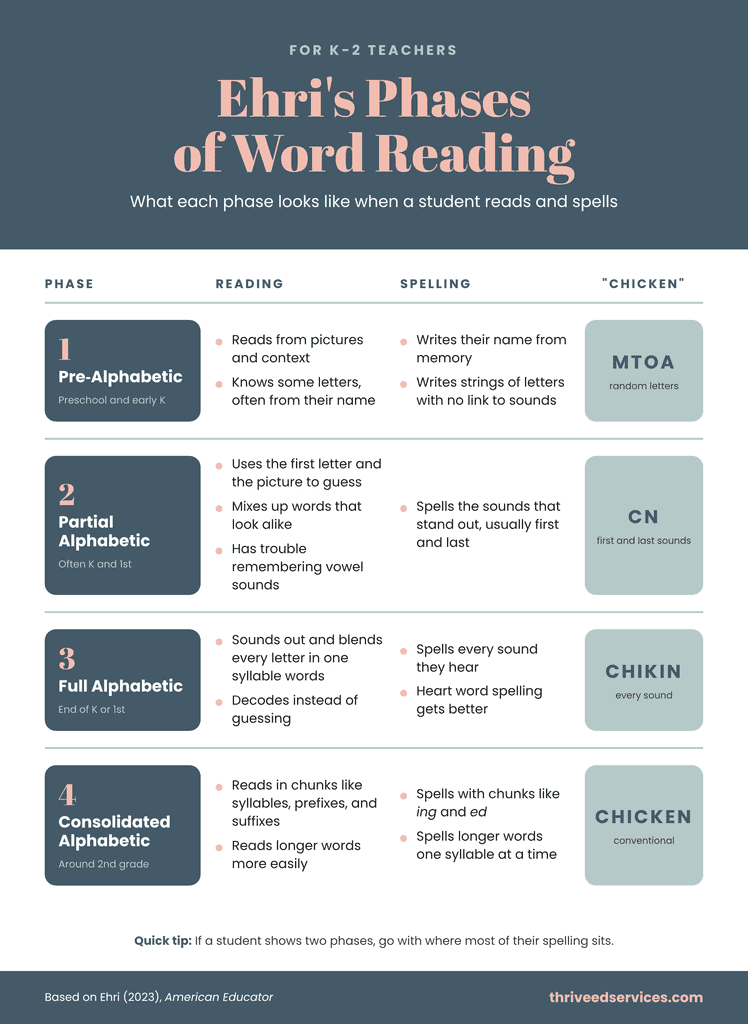
Pre-Alphabetic Phase
Reading: Students in this phase don’t connect letters to sounds yet, so they read from pictures and context. Ehri’s example is a child who “reads” McDonald’s from the golden arches instead of the letter M.
Spelling: They can often write their name, and they may write strings of letters to tell a story. The letters aren’t connected to sounds. Even their name is memorized as a shape.
You’ll see this phase mostly in preschool and at the start of kindergarten.

Partial Alphabetic Phase
Reading: These students know letter names and some letter sounds, usually consonants. They use the first letter, plus the picture, to figure out a word. They mix up words that look alike, and vowel sounds are hard for them to remember.
Spelling: They spell the sounds that stand out, usually the first and last ones. Ehri gives two examples of spellings from this phase: ML for mail and LFT for elephant.
This is where guessing lives. A student who looks at the first letter and the picture and says cheese isn’t being careless. They’re using everything they have, and they don’t have enough letter-sound knowledge yet to get through the rest of the word. If you want language for those moments, here are the four prompts I use instead of “look at the picture.”
Partial alphabetic is common in kindergarten and first grade. Older students who are still struggling with decoding can be in this phase too.
Full Alphabetic Phase
Reading: Students can sound out and blend every letter in a one syllable word. They’re slower than they’ll be later, but they’re decoding instead of guessing, and the words they decode start to stick.
Spelling: They spell every sound they hear, even when the spelling isn’t the conventional one yet. Their spelling of irregular high-frequency words (heart words) also improves in this phase.
That second point is a good thing to check. When a student can read said but spells it SED, you know the word isn’t fully mapped yet. My Dolch Sight Word Assessment Checklist has a reading assessment and a spelling assessment for all 220 Dolch words, so you can see both for each student.
With systematic phonics instruction, Ehri says students typically reach this phase by the end of kindergarten or in first grade.
Consolidated Alphabetic Phase
Reading: Students stop processing every single letter and start reading in chunks. Those chunks are syllables, prefixes, suffixes, and spelling patterns they’ve seen many times. Ehri’s example is interesting, read as in, ter, est, ing.
Spelling: They use those same chunks to spell. You’ll see endings like ing and ed spelled correctly, and longer words spelled one syllable at a time.
Ehri places this phase around second grade for students who’ve had systematic phonics in kindergarten and first grade.

One Word, Four Spellings
Spelling is the fastest way I know to see a student’s phase. When a student reads, they can lean on the picture, the sentence, or a word they’ve memorized. When they spell, there’s nothing to lean on. Every sound on the paper has to come from them.
Here’s what it can look like when you say the word chicken to four students:
- Pre-alphabetic: MTOA, a string of letters with no connection to the sounds
- Partial alphabetic: CN, the first and last sounds that stand out
- Full alphabetic: CHIKIN, with every sound represented but ck and the second vowel not conventional yet
- Consolidated: CHICKEN
It’s the same word on the same day, and you get four very different pictures of what each student knows. That’s more than a reading level tells you, and it took one word.
How to Find a Student’s Phase in Five Minutes
You’ll learn more from five minutes of watching a student read and spell than any leveled test will tell you. Here’s the check I use.
Step 1: Dictate four words. Pick a CVC word, a word with a digraph or blend, a heart word, and a word with two syllables. For example, mat, ship, said, and chicken.
Say: “I’m going to say a word. Say it back to me, then write it the best you can. It’s okay if you’re not sure.”
Don’t help with the sounds. You want to see what they do on their own.
Step 2: Have them read six words. Write six words on an index card with no pictures: two CVC words, two words with digraphs or blends, one heart word, and one word with two syllables.
Say: “Read these to me. If you get to one you don’t know, try your best.”
Pay attention to what happens on a word they don’t know. A student who says the first sound and then guesses is likely partial alphabetic. A student who sounds out every letter is likely full alphabetic, and one who breaks a longer word into parts is moving into consolidated.
Step 3: Ask yourself four questions.
- Can they read short words sound by sound?
- Are they guessing from pictures, or decoding from letters?
- Do they spell by sound, or copy from memory?
- Are they fluent, or still laboring over each word?
Step 4: Match it to a phase. Compare what you saw to the phase descriptions above. If a student shows behaviors from two phases, go with where most of their spelling sits. It’s harder to cover for missing letter-sound knowledge in spelling than in reading.
If you’d like something to walk you through it, my free Reading Phase Screener takes about five minutes and seven questions, and you don’t need an account to use it. Once you have the phase, the free Phase Skill Bank shows the kinds of practice that fit it.
Knowing the Phase Is Step One
The phase tells you where a student is right now. It doesn’t tell you what to teach on Monday. When I asked teachers what they struggle with, the answers sounded like this: “knowing where to start,” and “figuring out what sequence to teach, especially when learners already have some of the knowledge but are missing pieces.”
That’s what I’m covering in my free live workshop, What Do I Teach Next?, on Sunday, October 25. We’ll take the phase you found and work out what to teach next for students in each one. You’ll get a PD certificate for attending.

If you’re sharing this with families, here’s the parent version of this post. And once a student is working on a new skill, here’s how I decide when to move on to the next one.
Citations:
Ehri, L. C. (2023). Phases of Development in Learning to Read and Spell Words. American Educator, Fall 2023. 95 Percent Group, The Stages of Literacy Development.