What to Say When a Child Gets Stuck (4 Prompts That Replace Guessing)

This post may contain affiliate links, and I will earn a commission if you purchase through these links. Please read the disclosure policy for more details.
A child hesitates on a word he can’t read. You have five other kids at the table and four minutes left, so you say, “Look at the picture. What would make sense?”
So he says a word and you both move on.
But he didn’t read it. He guessed, and he got rewarded for guessing.
Whatever you say when they’re stuck is what they do when you’re not sitting there. The prompt is the strategy.
This post gives you four prompt swaps you can use tomorrow. It also gives you a plan for when a swap doesn’t work, and a two minute check for the child who can’t give you a first sound at all. You don’t need a new program for any of it.

I said this for years
“Look at the picture” was in my teacher prep, and it was in the manuals I was handed.
This was the model we were all trained on, and changing it starts with one sentence, not with throwing out your practice.
Why “what would make sense?” backfires
Eye tracking research, most associated with Keith Rayner, put cameras on readers’ eyes and found that skilled readers stop on nearly every meaningful word on the page and process the letters while stopped.
Reading feels fast because the letters to sounds part went automatic. Automatic is not the same as skipped.
Keith Stanovich’s work adds the other half. It’s the weaker readers who lean hardest on context. Strong decoders barely need it.
Put those together and you get the problem with the old prompt. When we tell a child to look at the picture, we’re teaching them to do what struggling readers do, not what strong readers do.
If you want the full case, including where three cueing hides in your posters, leveled books and sight word activities, that’s all in Is 3-Cueing Still in Your Classroom?.
“Look at the picture” is a phase 2 instruction
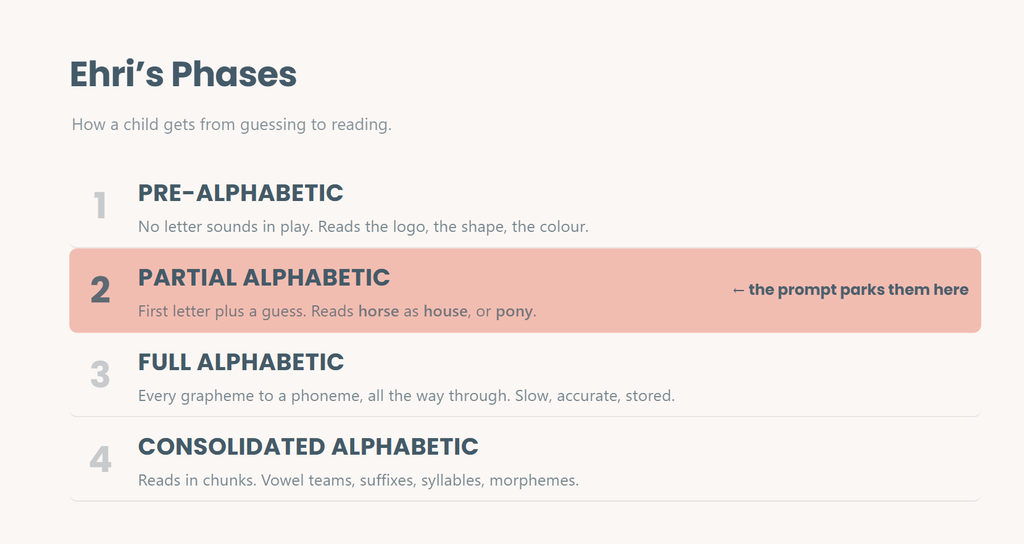
Linnea Ehri described four phases students move through as they learn to read words. Phase 2, partial alphabetic, is the one where a child knows some letters and sounds, usually the first and the last, and uses that first letter plus context to guess. That’s the child who reads horse as house or pony.
First letter plus context is the definition of partial alphabetic. It’s also exactly what “look at the picture, what would make sense” asks a child to do. So a student getting that prompt all year is practicing the phase they’re supposed to be leaving.
This causes problems for the student in the future. Words become automatic through orthographic mapping, which means the spelling, the pronunciation and the meaning get bonded together in memory. That bonding only happens when a child actually decodes the word sound by sound and connects it to a word they know.
Guessing doesn’t just get the word wrong today. It stops the word getting stored, so it’s still wrong next week.
The four prompt swaps
For each one, notice what the old prompt is actually asking the child to do. That’s the part that changes how you hear yourself say it.
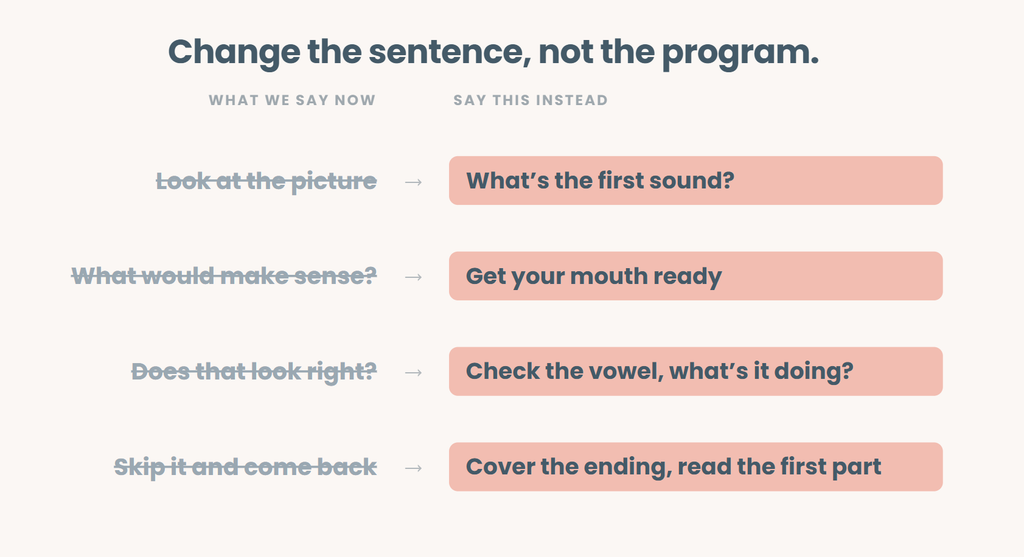
1. “Look at the picture” becomes “What’s the first sound?”
The old prompt takes the child’s eyes off the word. Every second on the picture is a second not spent on print, and they produce a word they never looked at.
The new prompt sends the eyes back to the letters and asks for the smallest possible task. It does not ask them to “read it,” which is what they already couldn’t do. Instead, it asks them to focus on the first sound. It’s a lower demand, still requires print, and is hard to fake.
Example: The text says The horse ran fast. The picture shows a pony.
Old prompt: the child says “pony.” It makes sense, it sounds right, and it gets logged as a good error. But they never read the word.
New prompt: the child says /h/. Now pony is off the table, because it doesn’t start with /h/.
2. “What would make sense?” becomes “Get your mouth ready”
This means physically forming the first sound before saying anything. Lips together for /m/. Teeth on lip for /f/. Tongue behind the teeth for /t/. The mouth goes into position for the first grapheme, and only then does the sound come out.
It works because it stops the blurt. A guess is fast. It comes out before the child has looked at anything. Setting the mouth first puts a physical gate in front of that impulse, and the gate is built out of the letter. You can’t get your mouth ready without looking at the word.
One caveat: “Get your mouth ready” is a starter, not the whole thing. If a child sets their mouth and then guesses the rest off that first sound, that’s still partial alphabetic with a good start. Follow it with “now go all the way through.”
3. “Does that look right?” becomes “Check the vowel. What’s it doing?”
The old prompt asks the child to compare a word they already guessed against the print. The guess comes first and the letters are only ever a check.
It’s also unusable as an instruction. A child who could tell whether it looked right would have read it. It gives them nowhere to put their eyes.
The new prompt sends them to the exact place the error usually is. Consonants are stable. Vowels are where English decoding gets hard, because the same letter takes several sounds depending on the pattern around it.
“What’s it doing” is shorthand for questions a child can answer. Is it on its own with a consonant after it? Is there a silent e? Are there two vowels together? Is there an r after it?
Worked example. A child reads rain as ran.
Old prompt: does that look right? It sort of does. The r, the a and the n are all there, so they say yes.
New prompt: they see two vowels together, ai, a vowel team, which says long a. The word is rain.
The second one told them where to look. The first one asked them to have an opinion.
4. “Skip it and come back” becomes “Cover the ending, read the first part”
The old prompt teaches something worse than a guess. It teaches that a hard word is optional and the way to handle difficulty is to go around it.
The new prompt makes a long word shorter without making it a different task. Cover the suffix, read the base, put the ending back.
Worked example. The word is planting. Cover ing, read plant, uncover, planting.
Two words on this list will trip you up if nobody warns you.
Unhappy has a prefix, so you cover the front instead of the ending. Same move, other end of the word.
Running has a doubled consonant. Cover ing and you’re left with runn, which isn’t a word. That extra n belongs to the ending, not to run. Say that one out loud before you use it with a student.
When the swap doesn’t work: the ladder
You’ll try a swap on Monday and it won’t work well the first time. That’s normal, and it’s the moment teachers go back to what they know, so this is where to go instead.
One prompt at a time, wait between each, never stack them.
- Wait. Three to five seconds of silence, and count it in your head. Many of us prompt at about one second, which is before the child has started. A lot of errors fix themselves here.
- “Get your mouth ready.”
- “Go all the way through.” Finger under the word, left to right, no skipping.
- “Check the vowel. What’s it doing?”
- Cover part of it. The ending, or split the syllables.
- Tell them the word.
If you want your students holding these steps instead of waiting on you to prompt every time, my decoding bookmarks put the steps in their hands. They’re free in my library, and you can grab them below.

Never end on a guess
This rule matters more than the exact steps.
When you tell a child the word, they repeat it, then reread the whole sentence with the correct word in place. The last thing that happens at that word has to be the child saying it right while looking at it, because that’s the read that gets stored.
Flexing the vowel
This is the move you need to do out loud in front of students.
Take the word bread. Start with /b/ /r/, then the team. The ea usually says long e, so try it. “Breed.” That isn’t a word you know, so it isn’t that one. Flex it. The ea also says short e. “Bread.”
Trying the other sound when the first one doesn’t make a real word has a name, set for variability, sometimes called flexing the vowel. Tunmer and Chapman’s research found it’s one of the stronger predictors of who takes off in decoding.
Do it messily and on purpose. The fumbling is the part students need to see because no worksheet models this for them.

When a child can’t give you the first sound at all
If a student can’t isolate the first sound of a spoken word, changing your prompt won’t fix it. The problem is deeper, and no prompt at the table will reach it.
Use this two minute check. Four questions, easiest to hardest:
- Initial sound. “Say mat. What’s the first sound in mat?” Looking for the sound /m/, not the letter name “em.”
- Final sound. “What’s the last sound in mat?” Looking for the sound /t/ (again not the letter name).
- Blending. “I’m going to say the sounds, you tell me the word. /s/ /u/ /n/.” Looking for sun.
- Segmenting. “Say all the sounds in ship.” Looking for /sh/ /i/ /p/, three sounds.
How to read it. Fails 1 or 3, back up to phonemic awareness before the prompts will land. Passes all four orally but still can’t do it in print, that’s letter sound knowledge, so run a quick phonics survey and find which sounds are missing. Passes everything and still guesses, that’s habit, and that’s exactly the child the swap list is built for. They need to practice reading correctly.
One thing about backing up, because it gets taken too far. Ehri’s meta analysis for the National Reading Panel found phonemic awareness instruction works better with letters than as pure oral work. Keep sounds and letters together, and skip the weeks of clapping syllables with no print in the room.
If your sound wall is organized by how the mouth makes each sound, it’s doing the same job as “get your mouth ready,” just on the wall. Mine is in the shop if you want one that’s ready to print.
Three ways this goes wrong
Don’t strip the pictures out of the room. This is the big one. Pictures build vocabulary, background knowledge and comprehension, and they’re most of why a five year old wants a book at all. The problem is using a picture to identify a word.
Pictures are for meaning. Letters are for words.
The practical version is two jobs → two texts. Decodable text when the job is decoding practice. Rich picture books when the job is comprehension and read aloud, where you do the reading and they do the thinking. More on that split in Decodable vs Leveled Books.
Don’t correct every error mid sentence. The wait time in the ladder is crucial. Jumping in at one second trains a child to wait for rescue.
Don’t throw the running record away. Keep watching what students do with real text. Stop coding errors M, S and V, because that coding is what trains you to see a meaning based guess as partial success. Record what they actually said and look at where in the word it broke down.
Start with one
Pick one swap and use it tomorrow.
“Look at the picture” becoming “What’s the first sound?” is the one I’d start with, because it’s the prompt that probably comes out of your mouth most and it’s the one with the fastest visible change at the table.
Join my list and get access to my vault of freebies, plus weekly emails with tips, new posts, and promotions!
*Most school spam filters block my emails, so please use a personal email.