The 1-1-1 Doubling Rule: When to Double the Last Consonant Before a Suffix

This post may contain affiliate links, and I will earn a commission if you purchase through these links. Please read the disclosure policy for more details.
You’re reading through a student’s journal and see “I was runing at recess.” A few lines down, “We went shoping.” It’s easy to circle both and think “careless mistake”.
These spellings follow a pattern, though. The student added the ending exactly the way they hear it. What they haven’t learned yet is the doubling rule, and it comes with a check students can run on their own writing.
Below is the rule, why English doubles the consonant, how to teach it, and a word list to use with your students.
What Is the Doubling Rule (the 1-1-1 Rule)?
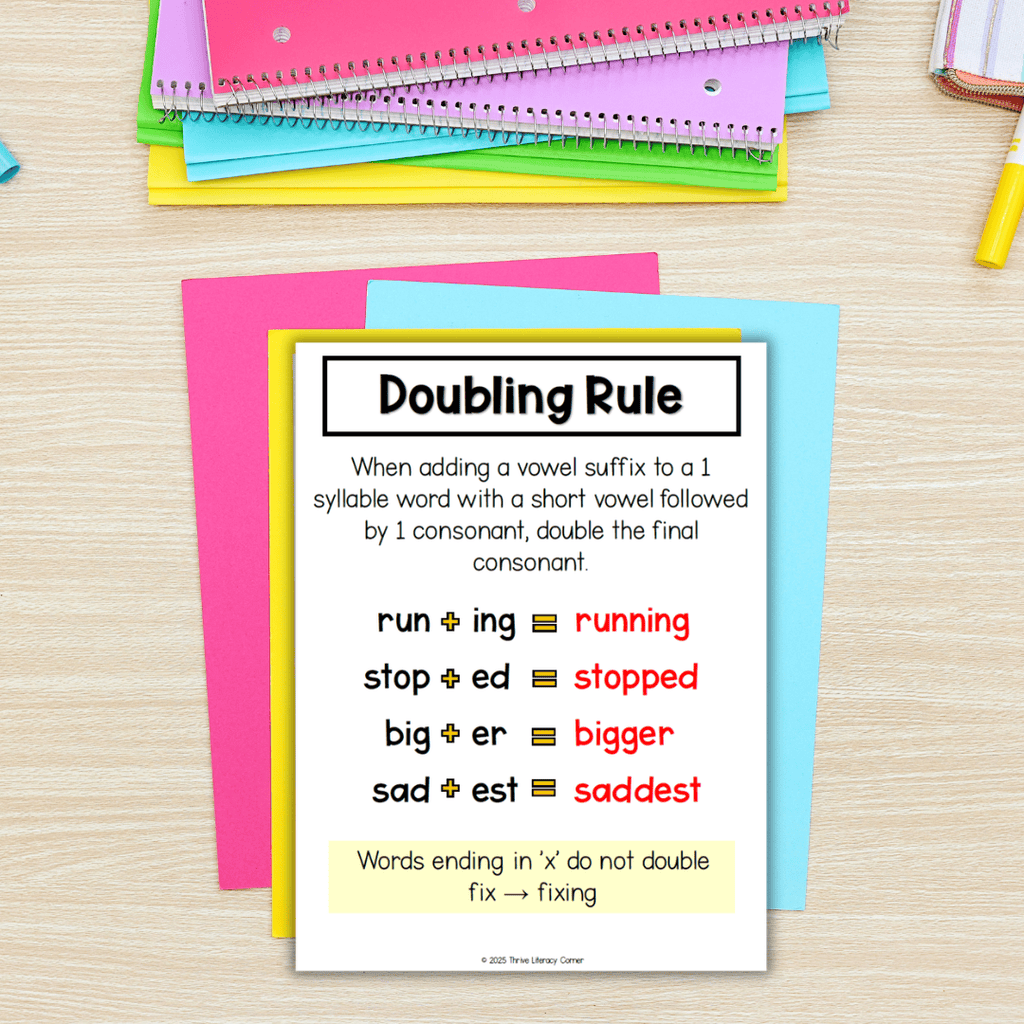
Here’s how I word it in my Complete Guide to English Phonics Rules: double the last consonant when adding a vowel suffix to words ending in one vowel followed by one consonant, only if the syllable before the suffix is stressed.
For students, shorten it to the 1-1-1 check. If a word has one syllable, one vowel, and one consonant at the end, double that consonant before an ending that starts with a vowel.
- run → running
- sit → sitting
- big → bigger
I don’t love the word rule for this, because English always has exceptions. With students, I call these patterns. The words that don’t fit get learned as heart words, the same way we teach irregular high-frequency words.
0Why Do We Double? Hopping vs. Hoping
Look at hopping and hoping. One letter changes both the vowel sound and the meaning.
Hopping comes from hop + ing. When students divide it into syllables, the two p’s split: hop/ping. The first syllable ends in a consonant, so it’s a closed syllable and the o stays short.
Hoping comes from hope + ing. The silent e drops before the vowel suffix, which is its own pattern and one of the jobs of silent e. That leaves one consonant between the vowels, so the word divides as ho/ping. The first syllable is open, and the o says its long sound.
So the doubled consonant keeps the syllable closed, and that keeps the vowel short. Students who know syllable division rules can watch this happen on paper.
This is a good example of why Louisa Moats argues that English spelling is more predictable than it looks. In How Spelling Supports Reading, she reports that about 50% of English words can be spelled from sound and letter patterns alone and another 34% with only one error. Once word meaning and origin are taken into account, only about 4% are truly irregular.
Vowel Suffixes vs. Consonant Suffixes
The doubling check only happens when the suffix starts with a vowel.
| Starts with a vowel: check the word | Starts with a consonant: just add it |
|---|---|
| -ing, -ed, -er, -est, -y, -en | -s, -ful, -ly, -ness, -less |
Compare these pairs:
- sad → sadder, but sad → sadness
- sun → sunny, but sun → suns
Teach students to look at the first letter of the suffix before they do anything else. If it’s a consonant, they add the ending and move on.
The 1-1-1 Check, Step by Step
- Look at the suffix. Does it start with a vowel? If not, just add it.
- Count the syllables. If the base word has one syllable, keep going. (Two syllables? See the stress section below.)
- Count the vowels. One vowel letter? Keep going.
- Look at the end. One consonant after that vowel? Double it.
Here’s what it sounds like when you model it:
“We’re adding -ing to hop. -ing starts with a vowel, so we check the word. Hop has one syllable. It has one vowel, o, and one consonant at the end, p. We double the p: hopping.”
The words that teach the check best are the ones that don’t pass it:
- jump + ing = jumping. Jump already ends in two consonants, m and p, so the syllable is closed and nothing doubles.
- rain + ed = rained. Rain has two vowels working as a team, so there’s no doubling.
- hope + ing = hoping. Hope ends in a silent e, so a different pattern applies: drop the e.
Mix words like these into practice from the first lesson. If students only ever see words that double, they start doubling everything.
Letters That Never Double: X, W, and Y
X spells two sounds, /k/ and /s/. Since it already closes the syllable, it never doubles: box → boxing, fix → fixed.
W and y at the end of a word aren’t working as consonants. They’re part of a vowel team, like ow in snow and ay in play. So snow → snowing and play → played.
One more to watch for is qu. In quit, the u is part of qu, so the word only has one vowel, i. That means quit → quitting follows the rule, and so does quiz → quizzes.
Words With Two Syllables: When Stress Decides
This is where the “stressed” part of the rule comes in. The stressed syllable is the one you say a little louder. Have students say the word and listen for it.
If the stress is on the last syllable, double the consonant:
- begin → beginning
- forget → forgetting
- admit → admitted
If the stress is on the first syllable, don’t:
- visit → visiting
- open → opened
- happen → happening
Some teachers call this the 2-1-1 rule. It usually comes after students are confident with words that have one syllable, often in 3rd grade.
If you’ve seen “travelling” in a book, that’s British spelling. British English doubles the l in travel even though the stress is on the first syllable. American English follows the stress pattern, so it’s traveling.
When to Teach the Doubling Rule
Teach it after closed syllables and the FLOSS rule, once students can read words with -ing and -ed. On my phonics rules hub, doubling sits in 2nd grade. The Common Core lists words like sitting under standard L.3.2e, so students are expected to apply it by 3rd grade.
Keep it in your review once you’ve taught it. Spelling stopped correctly on a Friday test and checking every -ed word in a journal entry are two different skills.
What the Research Says
Kids notice double letters early. In a study by Cassar and Treiman (1997), first graders picked nonsense spellings like baff over spellings like bbaf as looking more like a real word. They already sensed that doubles show up at the end of words, not the beginning.
Doubling before a suffix is harder, because the student has to see the base word inside the longer word. Nunes, Bryant, and Bindman (1997) found that children start using spellings like -ed before they understand why those spellings are there. A later study by Kemp, Mitchell, and Bryant (2017) found that many spellers, adults included, never reliably apply simple suffix rules like the plural -s. They lean on memorized spellings instead.
That’s the argument for teaching the check explicitly instead of waiting for students to pick it up from reading. A meta-analysis of 53 studies by Graham and Santangelo (2014) found that formal spelling instruction beat incidental approaches. The gains lasted, and they carried over to spelling in students’ own writing.
How to Teach the Doubling Rule
1. Start With Contrast Pairs
Write pairs on the board: hopping and hoping, tapping and taping, cutter and cuter. Read each pair out loud and have students tell you what changed.
“Listen. Hopping. Hoping. The vowel sound changed. Now look at the spelling. What’s different?”
Students point to the double p. “Those two p’s keep the o short.” Starting here lets students hear the reason before they learn the rule.
2. Model the 1-1-1 Check Out Loud
Use the script above with three or four words, and include one that doesn’t double. Think aloud through every step, even the ones that feel obvious. Then hand the next word to students while you write.
“Your turn. We’re adding -ed to plan. What do we check first?”
3. Double or Don’t Double Sort
Give students base word cards and a suffix card. They sort each word into two columns, Double and Just Add, then write the new word underneath: stop + ed = stopped.
Include words that fail the check for different reasons, like jump, rain, play, box, and hope. That way students practice every step of the check, not just the last one.
4. Build Word Sums
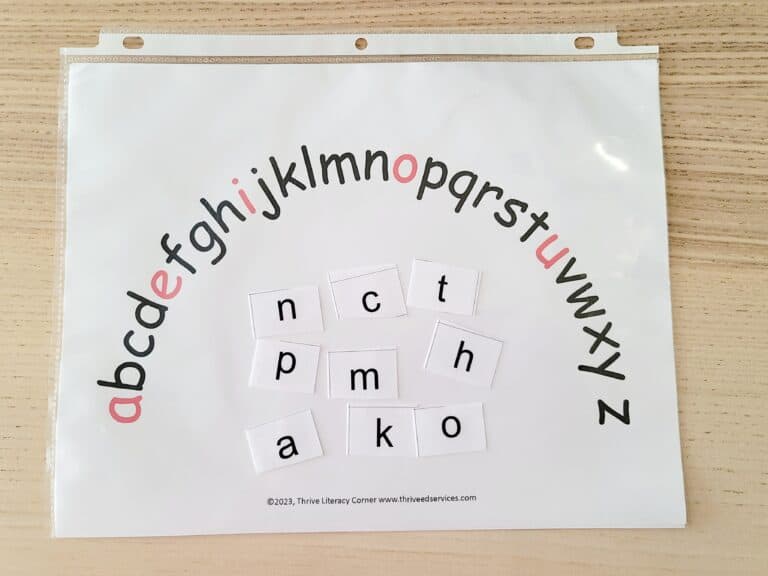
Have students write the base word and the suffix as a word sum on a whiteboard or with letter tiles: hop + ing. They add the second p as its own step and say why.
Word sums keep the base word visible, so students can see what they’re checking. If you already teach base words and suffixes, this fits right into your morphology instruction.
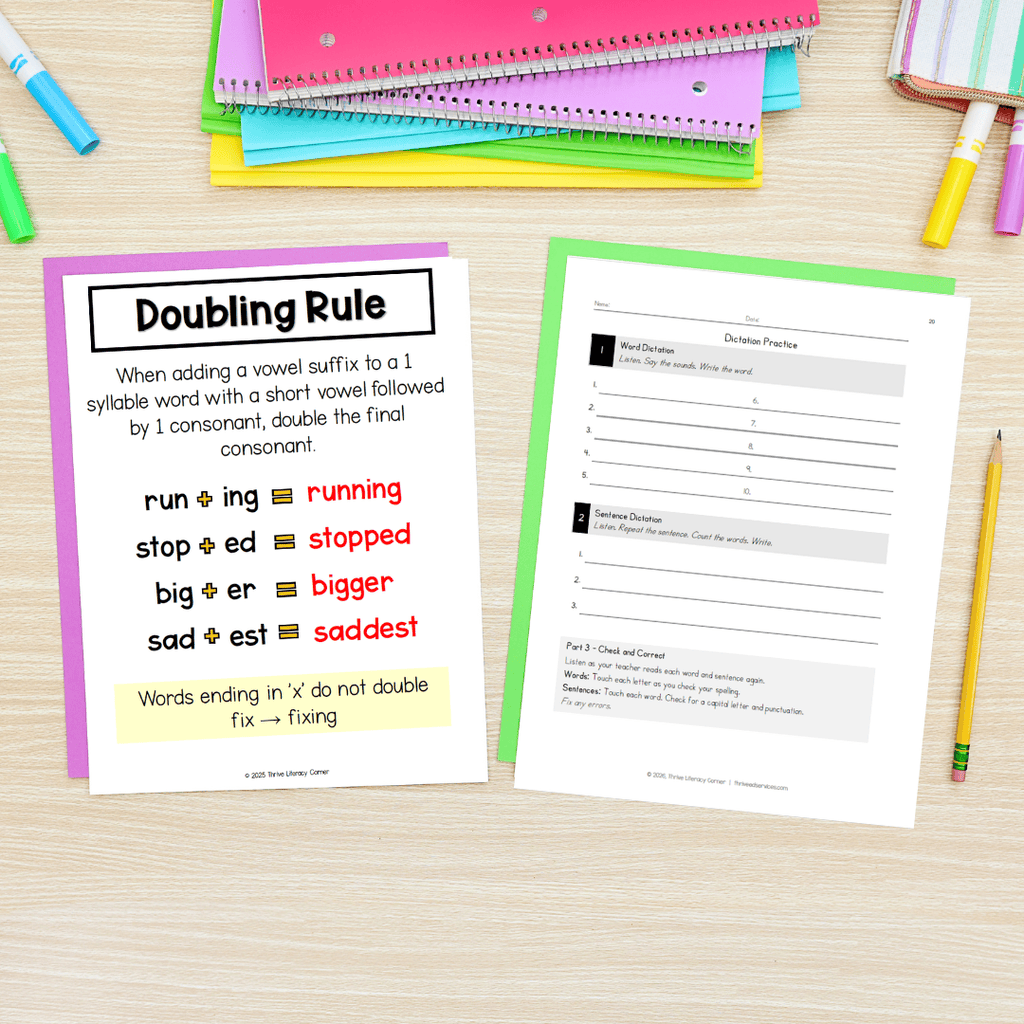
5. Dictation
Dictate words first, then sentences:
- The frog was hopping in the mud.
- We stopped to get a snack.
- My dog is bigger than your dog.
- I am hoping it snows.
Put at least one word that doesn’t double in every set. Before students hand it in, they check each word that ends in -ing or -ed.
Bonus: Hand the Check Over
Once students know the check, move it into their writing. After a journal entry, students circle every word that ends in -ing or -ed and run the 1-1-1 check on each one. This is how “runing” becomes “running” without you writing it in the margin.
Doubling Rule Word List
Double the consonant (one syllable)
- run → running, runner
- sit → sitting
- hop → hopped, hopping
- stop → stopped
- plan → planned
- swim → swimming, swimmer
- big → bigger, biggest
- hot → hotter, hottest
- sun → sunny
- fun → funny
- mud → muddy
- quit → quitting
Just add the suffix
- jump → jumping (two consonants at the end)
- help → helper (two consonants at the end)
- rain → rained (two vowels)
- read → reading (two vowels)
- play → playing (y is part of a vowel team)
- snow → snowing (w is part of a vowel team)
- box → boxes (x never doubles)
- sad → sadness (consonant suffix)
- hope → hoping (drop the silent e)
Two syllables
- Double: begin → beginning, forget → forgetting, admit → admitted, upset → upsetting
- Don’t double: visit → visiting, open → opened, happen → happening, garden → gardener
Grab 12 FREE phonics word lists & anchor charts by subscribing to my list!
*Most school spam filters block my emails, so please use a personal email.

Common Mistakes With the Doubling Rule
Doubling every word. Once students learn the rule, you’ll start seeing “jumpping” and “rainning.” They’ve learned the last step without the ones before it. Go back to the sort and add more words that don’t double.
Doubling before a consonant suffix. A spelling like “saddness” usually means the student didn’t look at the suffix first. Make that first step a habit: check the first letter of the ending.
Mixing it up with the drop the e rule. Hopping and hoping get confused in both directions. Teach the two patterns side by side with contrast pairs, so students learn to ask whether the base word ends in a silent e.

Resources for Teaching the Doubling Rule
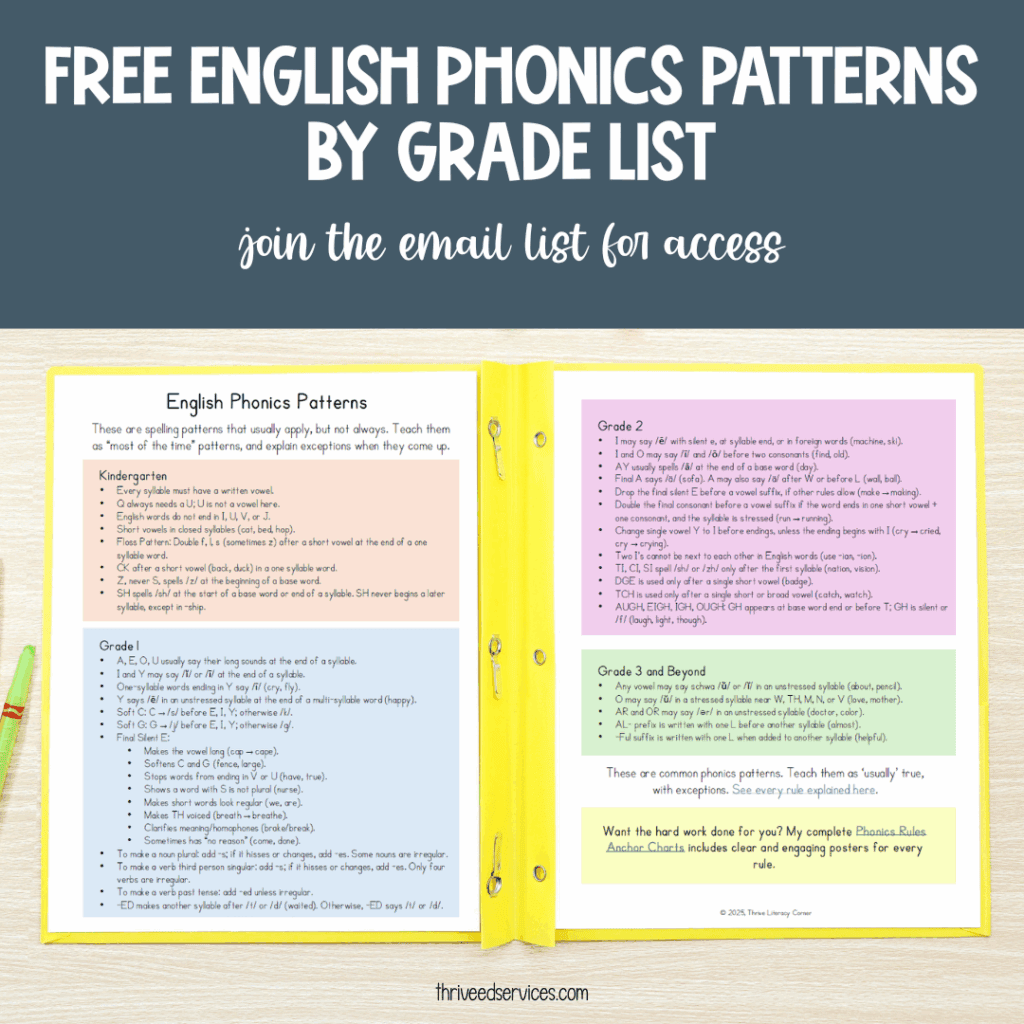
If you want the rule up on the wall, my Phonics Anchor Charts include a Doubling Rule chart. The set also has charts for the drop e and y to i rules that come right after it.
For a quick reference you can keep at your table, grab the free Phonics Rules Reference Chart from my Freebies Library. It’s two pages and covers every rule from my phonics rules hub. It also works well to send home for families.
Try the 1-1-1 Check This Week
When a student writes “runing,” they’re spelling what they hear. Teach them the 1-1-1 check with words that pass and words that fail, then let them use it on their own writing.
Pick five words from the list above and try the sort with one small group this week.