Free Parent Handout for Summer Reading (Science-Aligned and Ready to Send Home)

This post may contain affiliate links, and I will earn a commission if you purchase through these links. Please read the disclosure policy for more details.
You’ve spent the whole year building your students up as readers. The last thing you want is to watch those gains disappear over summer because parents didn’t know what to do at home.
The problem isn’t that parents don’t care. Most of them do. The problem is the advice they’re working with: read for 20 minutes a day, visit the library, pick books they’ll enjoy. For older kids, that’s fine. For K-2 readers who are still in the thick of phonics instruction, it misses the mark.
What your students need over summer isn’t just more reading. It’s the right kind of reading, done the right way. And that’s on us to communicate before school lets out.
Research shows that elementary students can lose 17-34% of the prior year’s learning gains during summer break. For K-2 readers, that includes phonics skills, not just comprehension.
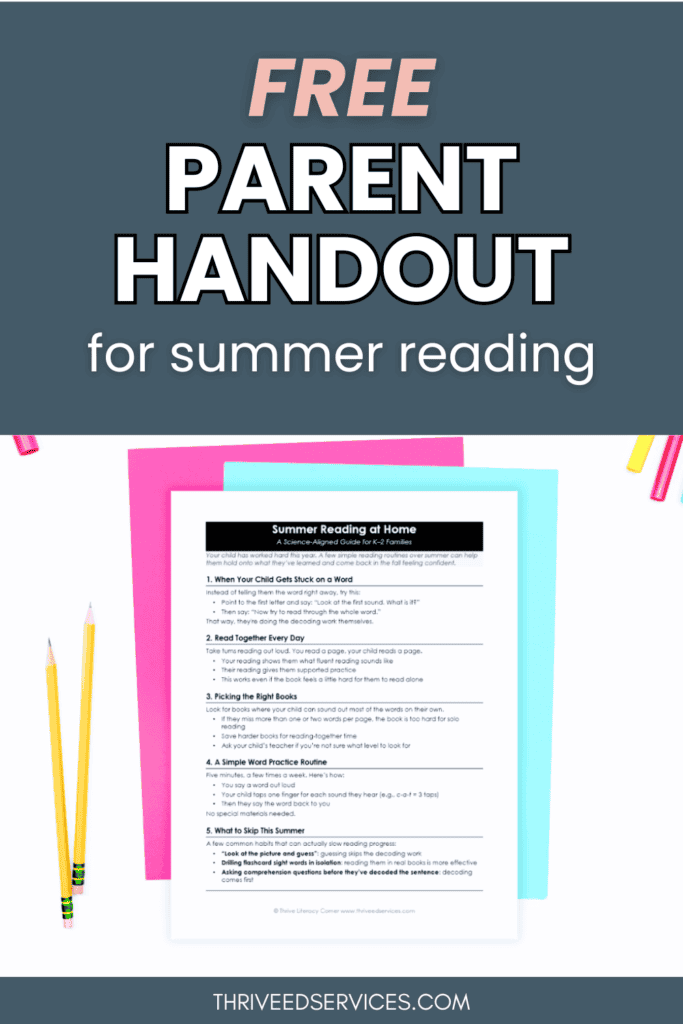
I made a free, print-and-send parent handout for exactly this. Put it in backpacks on the last day of school and parents have everything they need.
Why “Just Read Every Day” Falls Short for K-2 Readers
For a fluent reader, independent reading practice works well. They can pick up almost anything and get stronger just by reading it.
K-2 readers aren’t there yet. They’re still building the code, still mapping sounds to letters, still working on decoding words they’ve never seen before. When we send them home without any guidance, here’s what typically happens:
- Parents hand them a book that’s too hard and prompt them to guess from pictures
- Kids memorize books by sight instead of actually decoding the words
- Parents correct errors by just saying the word, which skips the decoding work entirely
- The focus shifts to comprehension before decoding is even solid
None of this is the parent’s fault. They’re doing what reading practice has always looked like. They just haven’t been told anything different.
Parents want practical ways to help, not a course in theory. They don’t need to know about orthographic mapping or the Simple View of Reading. They need three or four concrete things they can do at home with their kid. The handout gives them exactly that.
New to the Science of Reading?
Grab the free Science of Reading Quick Start Guide below – a simple 5-step framework to get started without the overwhelm.
SCIENCE OF READING QUICK START GUIDE
Grab your FREE guide with the 5 tools you need to get started with SOR!
*Most school spam filters block my emails, so please use a personal email.

What Summer Reading Should Actually Look Like
A one-sentence version you can use at pickup, in a newsletter, or at your last parent conference:
“The most important thing your child can do over summer is read books where they can sound out most of the words, not books that are too easy or too hard.”
Decodable readers, controlled text, or books at their independent reading level, whatever your students have access to. The point is that they’re actually decoding, not guessing or memorizing.
Read more: Should You Use Decodable Books or Leveled Books?
The Free Parent Handout
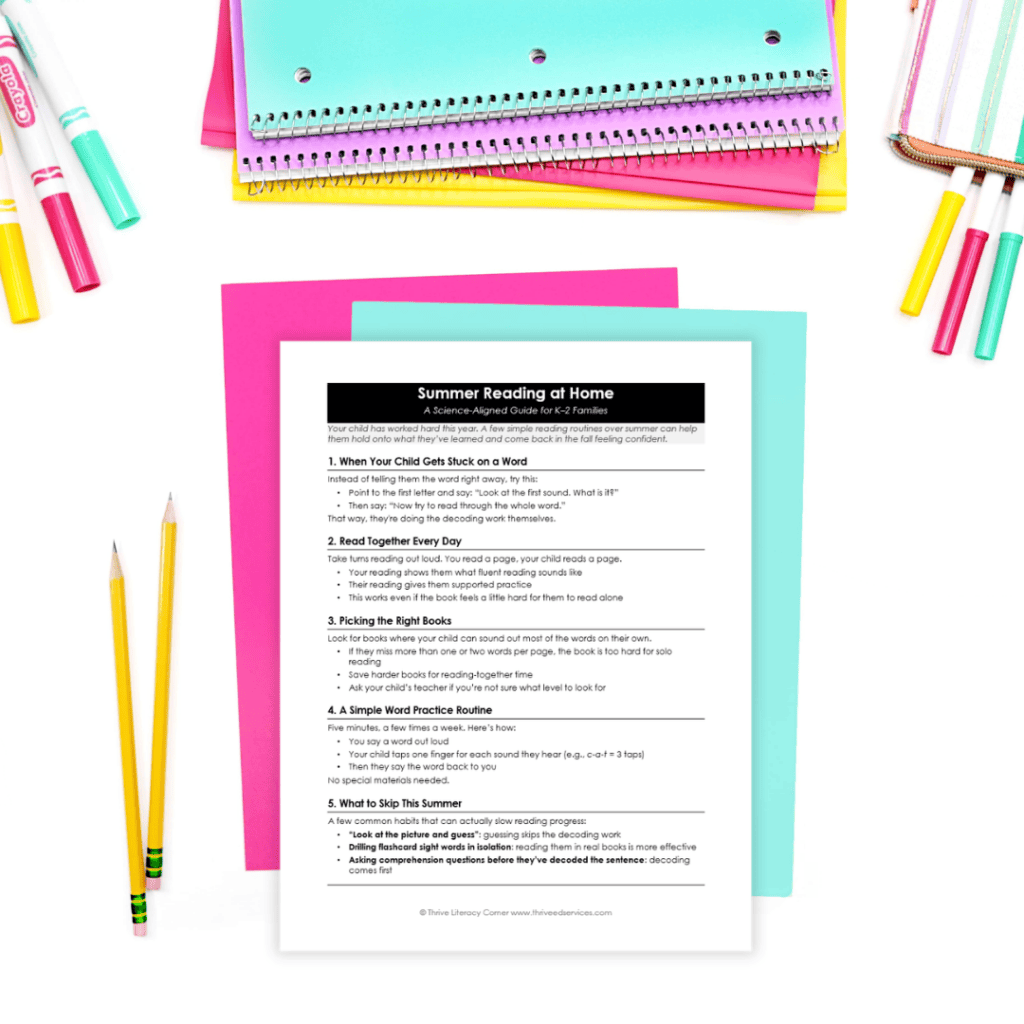
All general strategies that work across K-2, regardless of where a student is in their phonics sequence:
1. How to support your child when they get stuck on a word
Skip “just tell them the word.” Instead, parents can say: “Look at the first sound. What is it? Now try to read through the whole word.” This way, the child is focused on decoding the word.
2. How to do a short read-aloud together
Parent reads a page, child reads a page. The parent models fluent reading and the child gets supported practice. This works even when the child’s independent reading level is lower than the book they’re reading together.
3. What kind of books to look for
Books where the child can decode most of the words on their own. If they’re missing more than one or two words per page, the book is too hard for independent practice. Save harder books for read-aloud time.
4. A simple word practice routine
Five minutes, a few times a week: Parent says a word, child taps out the sounds on their fingers and reads it back. Nothing extra needed and easy enough for parents to do.
5. What to stop doing
Cut the “look at the picture and guess” prompt. Cut drilling random sight words in isolation. Cut asking comprehension questions before the child has even decoded the sentence correctly.
The parent handout is all the info on one page, in parent-friendly language, and ready to print.
DOWNLOAD THE FREE HANDOUT IN THE FREEBIES LIBRARY
Join my list and get access to my vault of freebies, plus weekly emails with tips, new posts, and promotions!
*Most school spam filters block my emails, so please use a personal email.

How to Use It
Three low-lift ways to get it home:
End-of-year packet. Slip it in with report cards or supply lists.
Pickup conversation. If a parent asks what to do over summer, hand them the sheet and say: “This has everything you need but let me know if you have any questions.”
Class newsletter or Dojo message. Copy and paste this: “I’m sending home a free summer reading guide this week. It has simple, research-based strategies for reading practice at home, no tutoring or curriculum required.”
Getting Your Students the Right Books
The handout covers the strategies. The other piece parents need is access to the right books.
If your students have been working through a phonics sequence this year, decodable readers are the best fit for summer practice. They’re built around the patterns students have already learned, so kids can actually decode them independently.
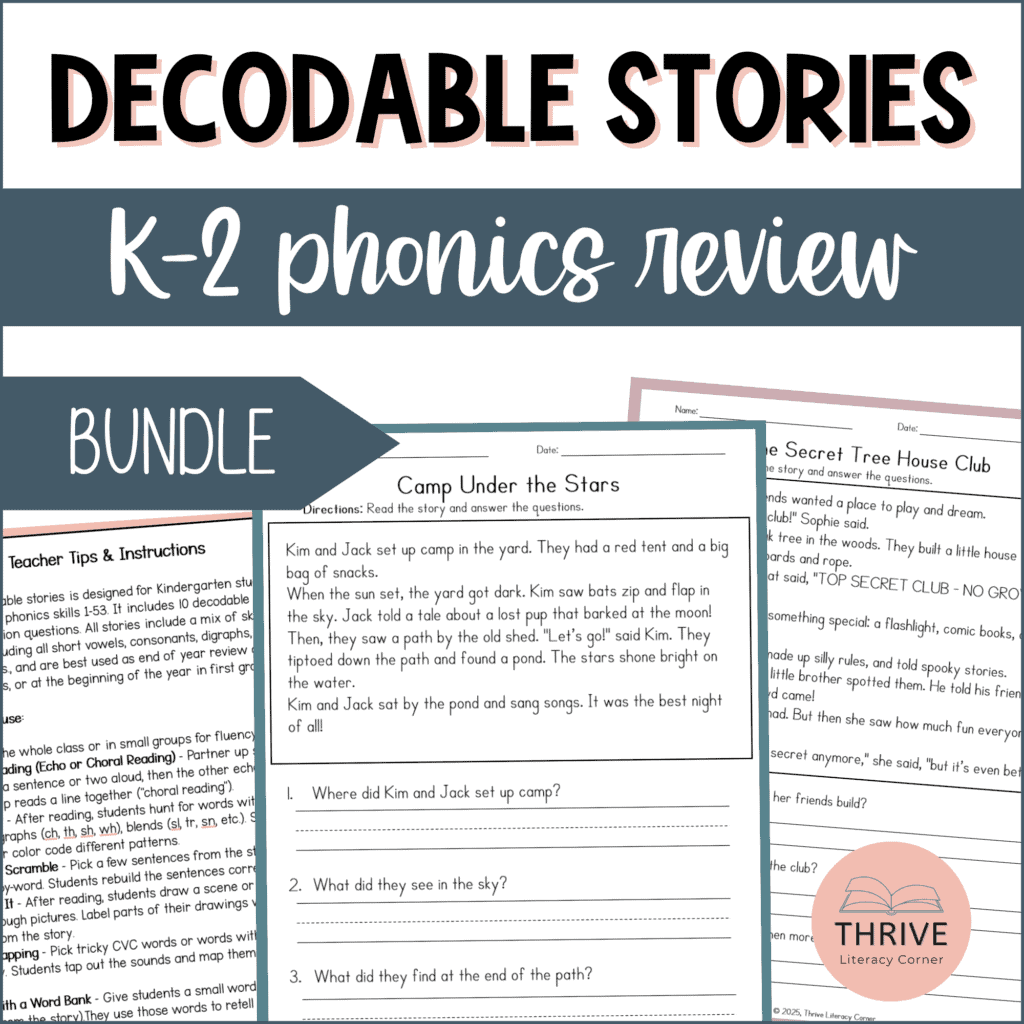
My Decodable Readers Bundle includes 30 decodable stories across kindergarten, first, and second grade levels, plus summer-themed centers and digital phonics games.
Read more: Ultimate List of Decodable Readers
One Handout. One Less Thing to Worry About in August.
Download the free handout, print a class set, and put it in backpacks this week.
Want more end-of-year resources? Check out the free Summer Reading Log from the Thrive freebies library.
Sources
Atteberry, A., & McEachin, A. (2021). School’s out: The role of summers in understanding achievement disparities. American Educational Research Journal.