3 End-of-Year Phonics Tasks That Take 1 Hour and Make September Easier

This post may contain affiliate links, and I will earn a commission if you purchase through these links. Please read the disclosure policy for more details.

The last week of school is not the time to plan next year.
You’re exhausted. Your students are restless. The classroom looks like a paper tornado hit it. The last thing anyone wants to do is sit down with a blank planning doc and think about fall.
But there’s one thing worth doing before you lock the door for summer. And it’s not planning. It’s capturing.
Right now, at the end of May, you have something you will not have in August: a clear memory of how this year actually went. What worked. What flopped. What you meant to change and never got around to.
By the time you walk back in, most of that is gone.
This isn’t about continuing with the same students or carrying anything over. Your class will be completely different next year. You might even be in a different grade. These three tasks have nothing to do with the kids you taught this year. They’re about getting your own professional thinking out of your head and somewhere you can actually use it later.
It takes about an hour.
Why Right Now Is the Best Time
Most teachers think summer is when they’ll reflect and plan. But summer-you doesn’t have the information end-of-May-you has.
Right now, you remember which phonics unit felt rushed. You remember the lesson that landed better than you expected. You remember thinking “next year I need to slow down here” while you were standing in the middle of it.
August-you walks in with none of that. A fresh room, a fresh class, and a blank memory of how this year felt on the ground.
These three tasks close the gap between those two versions of you.

Task 1: Get It Out of Your Head
This is a brain dump, not a report. Don’t fill this out for your admin or write it like a curriculum document. Just capture your own thinking while it’s still fresh.
Grab a piece of paper or open a blank doc. Work through these prompts:
- What phonics skills did I rush or under-teach this year?
- What units needed more time than I gave them?
- What did I teach that worked better than I expected?
- What do I wish I’d covered before winter or spring break?
- What would I slow down, move earlier, or cut if I could go back?
- What’s one thing I’d want to remember when I’m building my pacing plan next fall?
Bullet points are fine. Even a few words next to each prompt is enough. Don’t try to solve anything right now. Just leave notes for the person who will walk back in August with no memory of this year.
Save it somewhere you’ll actually find it. A folder in Google Drive labeled “Start Here” works better than a sticky note on your desk.
Task 2: Organize Your Materials
Unglamorous, but completely worth it.
Before you pack up your room, spend 20 minutes going through your phonics materials. August-you should be able to open a bin and find what they need without digging.
Here’s what to do:
- Label everything by skill, not by vague category. Not “misc phonics” – blends, digraphs, short vowels, whatever your sequence actually is.
- Pull anything you didn’t use. Set it aside. It doesn’t have to go in the trash, but it shouldn’t be taking up prime real estate in your bins.
- Toss or recycle anything worn out, incomplete, or that you know you’ll never reach for again. If you’re keeping it out of guilt, it’s not helping anyone.
The goal is simple: what you actually use should be easy to find. Everything else gets out of the way.
Task 3: Flag Your Go-Tos
This one takes ten minutes and saves you an hour of second-guessing in August.
Look at what you have and mark the things that actually worked. The centers that ran independently. The decodable sets that were easy to assign across levels. The activities your students picked up fast and could do on their own.
No formal system needed. A sticky note on a bin, a starred folder in Drive, a single line in your brain dump doc – whatever works. The point is that when you walk back in and you’re standing in front of your shelves trying to decide what to pull for the first week, you’re not starting from zero.
What Not to Do
Do not spend this hour planning full units. Do not start building new resources. Do not try to solve the problems you just identified in Task 1.
The brain dump is not a to-do list. It’s a record.
If you see something in your notes and feel the pull to start planning around it, write it down and close the doc. That work belongs in August or September when you have the context and the energy to do it well. Trying to fix everything now, at the end of a long year, leads to poor planning or burnout before summer even starts.
Close the door. Trust the notes you left yourself. Come back when you’re ready.
A Note if Your Curriculum Is Scripted
If you’re working with a mandated curriculum and some of this feels out of your control, Tasks 1 and 3 still apply. Your brain dump might look more like notes on what you’d want to flag in a curriculum meeting – what students needed more of, what moved too fast, what you’d push back on. That’s still worth capturing.
Your professional observations matter, even when someone else wrote the script.
Resources
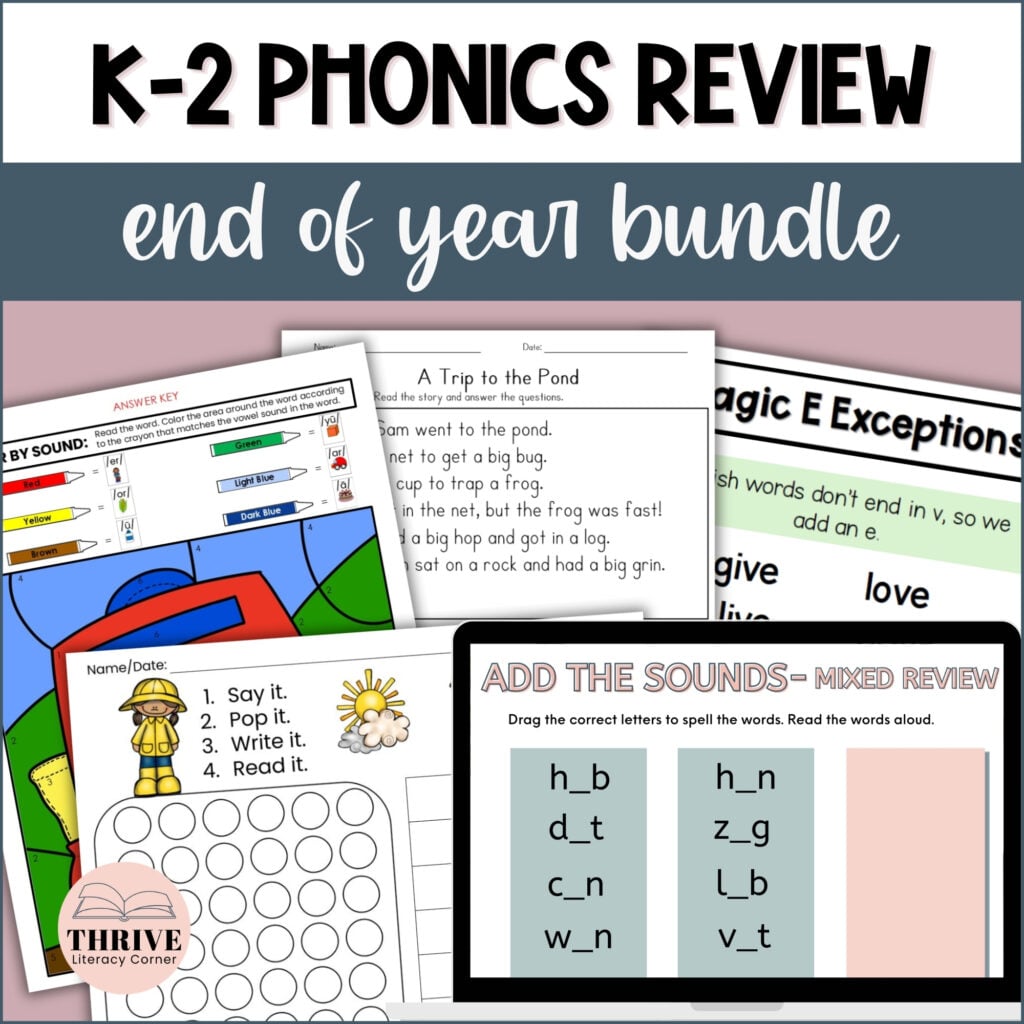
If you still have a few weeks of instruction left and you’re looking for something your students can run independently while you handle end-of-year logistics, the End-of-Year Phonics Survival Kit has everything in one place. Decodable readers sorted by level, word mapping mats, color by code sheets, and digital games. No new instruction needed. Grab it in [my TPT shop here].
And if you missed it, The Last 3 Weeks: What Actually Works for K-2 Phonics Review is a good companion read.
Save this or share it with a colleague who needs permission to keep it simple.