Why Small Group Practice Isn’t “Sticking” (And What to Adjust First)

This post may contain affiliate links, and I will earn a commission if you purchase through these links. Please read the disclosure policy for more details.

You’ve planned the lessons. You’ve pulled the groups. Your students are working through activities, practicing their sounds, reading their decodables.
And yet… progress feels slow. Or stuck. Or like you’re running in place.
If you’ve ever sat with a small group thinking, “They’re doing the work. Why isn’t this clicking?”, you’re not alone.
Here’s what I’ve learned after years of sitting with struggling readers: practice doesn’t always equal progress.
Sometimes students can be busy, compliant, and working hard… and still not move forward.
Not because they aren’t trying. Not because you’re doing something wrong.
But because the practice doesn’t match the exact skill gap they have.
SCIENCE OF READING QUICK START GUIDE
Grab your FREE guide with the 5 tools you need to get started with SOR!
*Most school spam filters block my emails, so please use a personal email.

What “Not Sticking” Looks Like in Small Groups
You might notice:
- Students can complete the worksheet but still can’t read the words in a sentence.
- They’re practicing letter sounds but still can’t blend them into words.
- They’re reading decodables but skipping over the exact patterns you just taught.
- They seem to “get it” during the lesson, but forget it by the next day.
That’s frustrating. And it often leads teachers to think:
Do I need more time?
Better materials?
Another activity?
But more practice won’t help if the target is off.
Why Intervention Stalls (Even When You’re Doing “All the Right Things”)
Here are the most common reasons small group practice doesn’t stick:
1. The practice doesn’t match where the breakdown actually is.
A student might struggle with reading CVC words, but the real issue is phonemic awareness. They can’t hear the individual sounds yet, so no amount of blending practice will help until that foundation is there.
2. The task is too hard (or too easy) for where they are.
If students are guessing their way through, the task is too hard. If they’re breezing through without thinking, it’s too easy. Neither one builds the skill.
3. There’s no connection between isolated practice and real reading.
Students might nail the flashcards but freeze when they see the same word in a sentence. That’s a sign the practice hasn’t transferred to actual reading yet.
4. They’re practicing the skill, but not getting enough repetition.
One day of word mapping isn’t enough. One round of blending drills isn’t enough. Students need repeated, targeted exposure to truly internalize a skill.

If You Notice This… Try This Instead
This is where many small groups turn a corner.
Below are common “stuck” moments, and what to do right away.
If students can complete the worksheet but can’t read the sentence…
What’s likely happening:
They’re completing the task visually or by memory, not actually reading.
Try this instead:
- Put the worksheet away.
- Write 2–3 of the same words in a short sentence.
- Have students point under each word as they read.
- Listen closely for guessing.
- Reread the same sentence multiple times before moving on.
Reading matters more than finishing the page.
If students know letter sounds but can’t blend them…
What’s likely happening:
The breakdown is phonemic awareness, not phonics.
Try this instead:
- Step away from print for a few minutes.
- Practice oral blending with sounds only.
- Use continuous sounds when possible.
- Add arm tapping or sound boxes.
- Go back to letters only after blending sounds feels smoother.
Letters won’t help if the sounds aren’t solid yet.

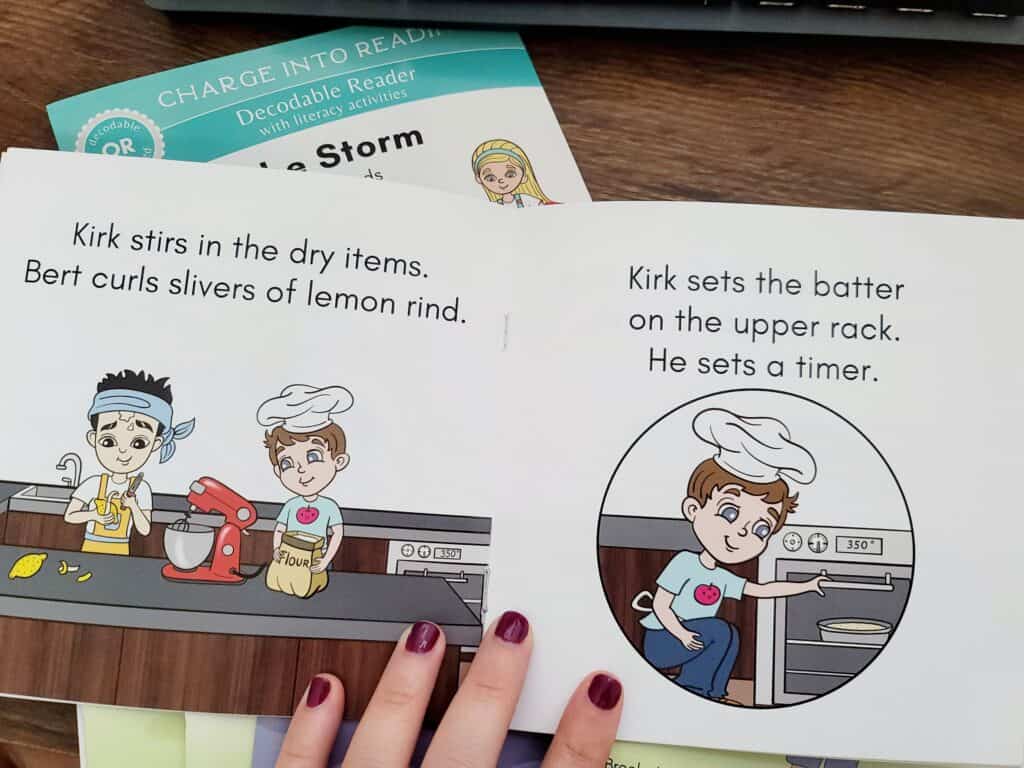
If students guess while reading decodables…
What’s likely happening:
The text is ahead of their control with the pattern.
Try this instead:
- Cover the page and read one sentence at a time.
- Use a tracking tool or finger under each word.
- Slow the pace way down.
- Reread the same sentence until it sounds accurate and smooth.
- Stop the book early if accuracy drops.
Finishing the book is not the goal. Accurate reading is.
If students “get it” during the lesson but forget by the next day…
What’s likely happening:
They need more repetition with fewer skills at once.
Try this instead:
- Choose one skill only.
- Practice it for several days in a row.
- Keep the format simple and familiar.
- Change how they practice, not what they practice.
Depth beats variety every time.
If students breeze through everything but still aren’t growing…
What’s likely happening:
The work may be too easy or not requiring real thinking.
Try this instead:
- Add oral reading.
- Increase accuracy expectations.
- Mix reading and spelling with the same words.
- Ask students to explain how they read the word.
Effort should feel just a little uncomfortable, but doable.
How to Tell If Practice Matches the Skill
Ask yourself:
- Can my student do this task independently after I model it? If not, it’s too hard right now.
- Does this activity require them to use the exact skill I’m trying to build? Or is it just keeping them busy?
- Am I seeing progress over time, or does it feel like we’re starting over every session?
If something feels off, trust that instinct. You’re probably right.
What Targeted Practice Actually Looks Like Over a Few Days
Targeted doesn’t mean boring. It means focused.
Here’s what that might look like for one skill:
Day 1
- Clear modeling
- Heavy support
- Slow pace
- Lots of guided practice
Day 2
- Same skill
- Lighter support
- Different format (cards, whiteboard, oral work)
Day 3
- Same skill
- Apply it inside connected reading
- Short, controlled text
- Rereading for accuracy
One Adjustment You Can Make This Week
Pick one student who feels stuck. Not the whole group. Just one.
Ask: What exact skill is missing? Not the activity, the skill.
Then plan the next few sessions around only that.
For example:
- If blending is weak, spend multiple days blending with known sounds.
- If short vowels are mixed up, sort and map only those vowels.
- If reading accuracy is shaky, read one sentence at a time with full attention.
It may feel slower at first. But this is what actually moves students forward..
You’re Not Failing, You’re Refining
If small group practice isn’t sticking, it doesn’t mean you’re doing it wrong.
It means you’re paying attention. Noticing. Adjusting.
That’s exactly what good intervention looks like.
Sometimes the most powerful thing you can do is simplify, narrow your focus, and give students exactly what they need, not more, just more targeted.
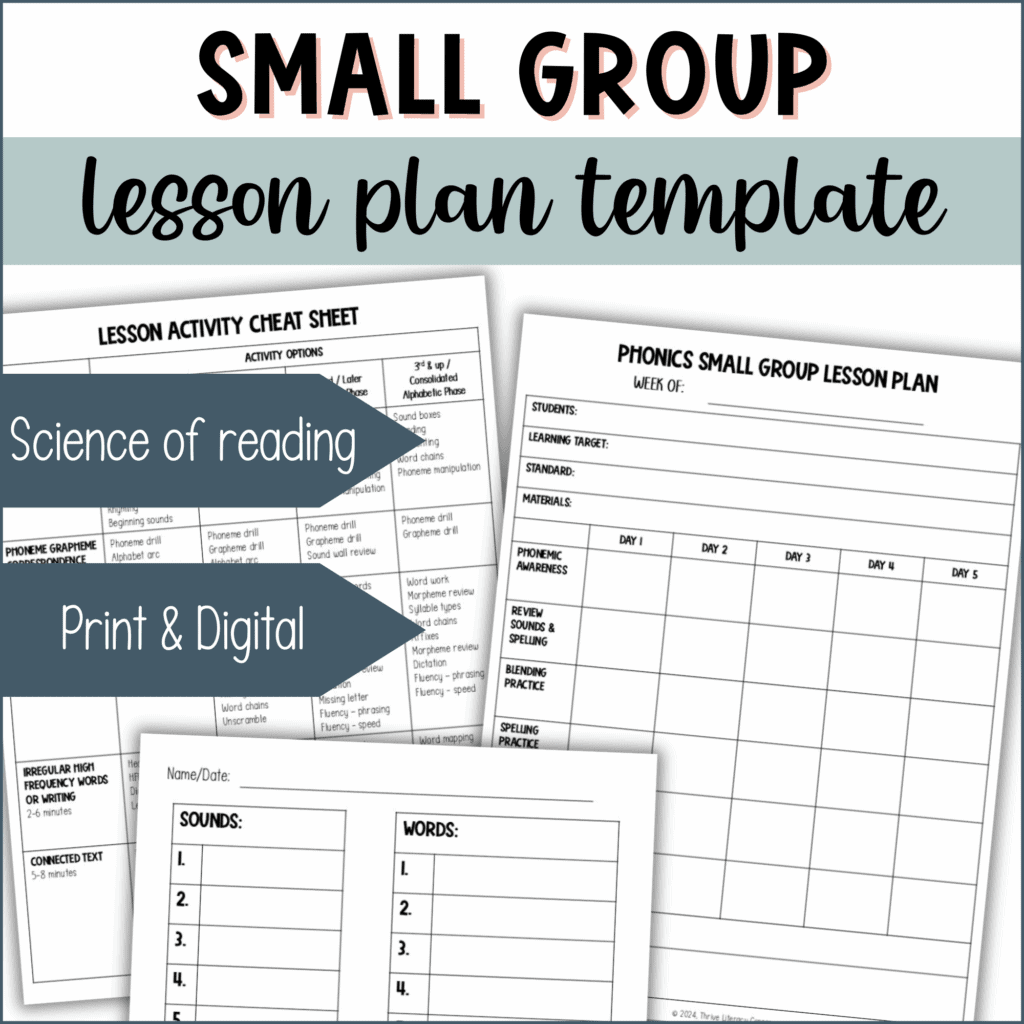
Want Help Planning Small Groups Without Guessing?
If choosing the right activity feels harder than teaching the lesson itself, my Small Group Lesson Plan Templates are built for exactly this.
They help you:
- Keep lessons focused and manageable
- Identify the skill first
- Match practice to student need
It’s one less decision to make, and a lot more confidence at the small group table.