Z vs. S: How to Teach Students Which One Spells /z/

This post may contain affiliate links, and I will earn a commission if you purchase through these links. Please read the disclosure policy for more details.
Here’s something that trips up a lot of students – and honestly, a lot of teachers too.
The /z/ sound can be spelled two different ways: with Z or with S. And both are correct. The key is knowing when to use which one.
This is one of those phonics rules that seems almost too simple to teach. But once students understand it, the guessing stops.
A quick note: You’ll hear this called a rule, but I like to frame it as a pattern. Most of the time it works this way, but not always. When I introduce it to kids, I tell them: “This is what usually happens in English words, but there are some exceptions we’ll learn together.”
S Is Actually the Most Common Spelling of /z/
This surprises a lot of people.
When most of us think about the /z/ sound, we think of the letter Z. But S is actually the most common way to spell /z/ in English.
You see it all the time in everyday words – dogs, fans, wins. That final S? It’s not making a /s/ sound. It’s making a /z/ sound.
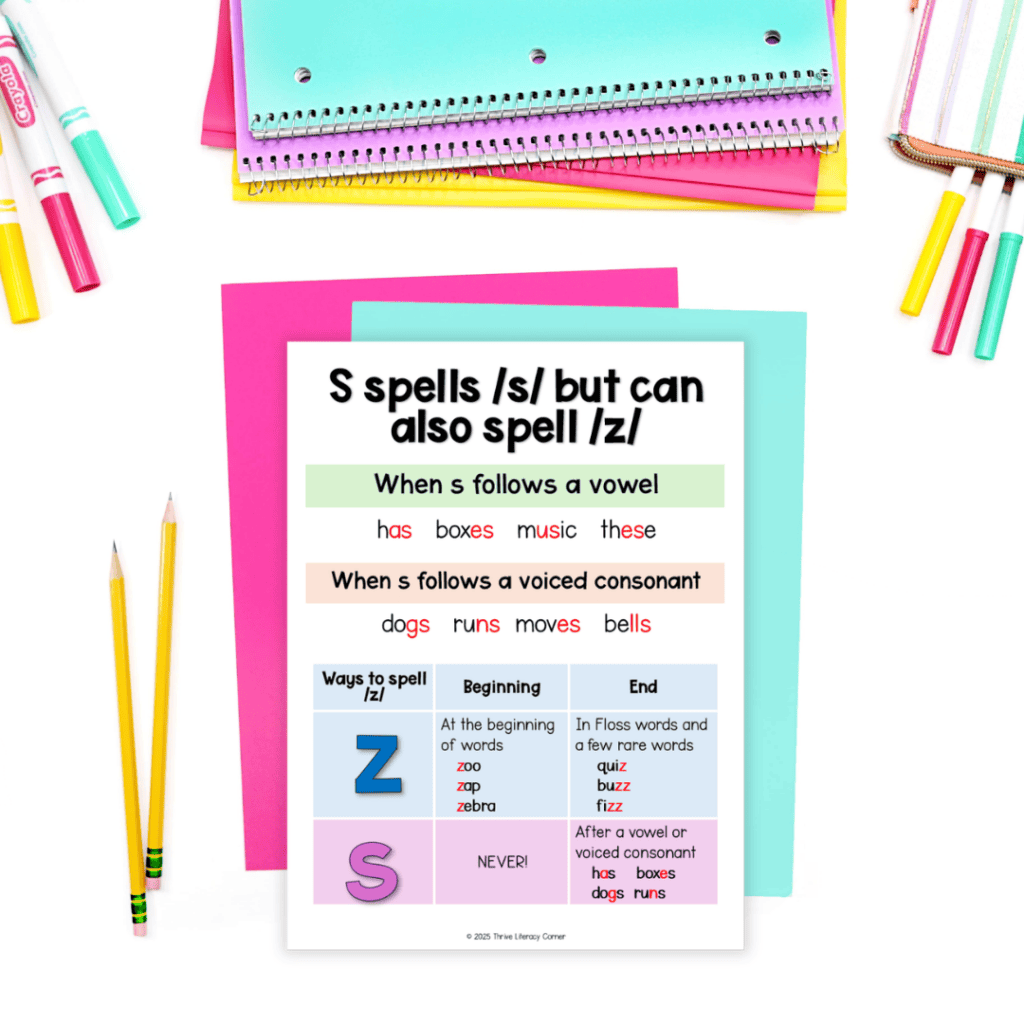
But here’s the rule: S only spells /z/ at the end of a word, and only when it follows a voiced sound.
Think about the difference between cats and dogs. In cats, the T before the S is voiceless – so the S stays /s/. In dogs, the G before the S is voiced – so the S becomes /z/.
(Not sure what voiced sounds are? Voiced consonant sounds include: /b/, /d/, /g/, /j/, /l/, /m/, /n/, /r/, /v/, /w/, /y/, /z/, /ng/, /th/ as in ‘that’. All vowels are also voiced.)
More examples of S spelling /z/ after a voiced sound:
- fans – the N is voiced, so the S = /z/
- wins – the N is voiced, so the S = /z/
- dogs – the G is voiced, so the S = /z/
- beds – the D is voiced, so the S = /z/
- runs – the N is voiced, so the S = /z/
When students understand this pattern, they stop seeing the final S as random. It follows a rule.
So When Does Z Come In?
Z spells /z/ at the beginning of base words.
That’s the distinction. If you hear /z/ at the start of a word, it’s spelled with Z, not S.
Think: zoo, zip, zigzag, zero, zone, zap, zoom, zest.
Every one of those starts with Z.
This is where students sometimes get confused. They’ve learned that S can spell /z/, which is true, but they don’t yet understand that S only does that job at the end of a word after a voiced sound. At the beginning of a word, Z is the spelling.
Z and S can both spell /z/. The rule is about where each one works.
A Note on Exceptions
Like most phonics rules, this one has a small exception worth knowing about.
Words with Greek origins sometimes use X to spell /z/ at the beginning – xylophone being the most common example students might encounter. These are rare in K-5 instruction, but if a student asks why xylophone doesn’t start with Z, you can simply explain that it comes from Greek, and Greek-origin words sometimes follow different spelling patterns.
For most of what your students are reading and writing, the rule holds: if you hear /z/ at the beginning of a word, it’s spelled with Z.
Teaching Both Sides of the Rule
We don’t just teach rules, we show students how they apply in real words.
That means teaching both sides of this pattern explicitly so students have the full picture:
Side 1: S spells /z/ after a voiced sound.
- dogs, fans, wins, beds, runs
- The sound before S is voiced – and that’s what makes S say /z/
Side 2: Z spells /z/ at the beginning of base words.
- zoo, zip, zero, zebra, zone
- If you hear /z/ at the start, reach for Z
When students have both sides of this rule, they’re not guessing. They’re applying a pattern.
Here’s a simple way to teach it:
Step 1: Name both rules. Put them side by side so students can see the comparison. “S spells /z/ after a voiced sound. Z spells /z/ at the beginning of a word.”
Step 2: Show examples for each. Don’t just list them – let students practice sorting words into the two categories. Which words have S spelling /z/? Which have Z spelling /z/?
Step 3: Talk about position. This is the key concept – where in the word does the /z/ sound appear? Beginning or end? That’s one clue that helps determines the spelling.
Step 4: Reference the anchor chart. This anchor chart gives kids a visual reminder of both patterns. Keep it posted during phonics time and refer back to it anytime you’re introducing or reviewing /z/.

Why Visuals Matter for Spelling Rules
Teaching a rule once isn’t enough.
Students need to see it, use it, and come back to it over time. A well-designed anchor chart does exactly that – it keeps the rule visible so students can reference it while they’re working, not just during the moment of instruction.
You can use the poster in whole group, then shrink it for student notebooks. That way the support goes with them instead of staying on the wall.
This is part of building true orthographic knowledge – not just memorizing, but helping students recognize consistent patterns in how words are spelled. Once they see this rule in action, they start applying it naturally.
A Quick Word Sort to Try
Here’s a simple sorting activity to reinforce both sides of the rule:
Z at the beginning:
- zoo, zip, zigzag, zero, zone, zap, zoom, zest
S spells /z/ after voiced sounds:
- dogs, fans, wins, beds, runs, tells, hums
Have students sort the words, then ask: “What do you notice? Where does Z appear? Where does S spell /z/?” Let them articulate the pattern before you confirm it.
When students can explain a rule, they’re far more likely to apply it.

Connecting the Rule to Encoding
Phonics instruction isn’t just about reading – it’s also about spelling.
When students know both sides of this rule, they have clear guidance for writing too. They’re not pausing over zip wondering which letter to reach for, or second-guessing why dogs ends in S but sounds like it ends in Z.
They know. Because they’ve been taught.
Teaching sound-spelling rules gives kids a strong decoding foundation. And the /z/ rule is a great place to start because it’s clear, predictable, and easy to practice. It’s one of those rules that seems simple but makes a big difference.
You’re not just telling them. You’re showing them patterns they can use.

Grab the Phonics Anchor Charts
If you want a ready-made visual for this rule, and dozens of others, the Phonics Anchor Charts resource has you covered.
Each chart is designed to make spelling patterns clear and memorable, so students have something to look at, reference, and internalize over time. You can use them in whole group, post them in your small group area, or shrink them for student notebooks.
See the rule supports + grab the charts here. (Flash sale Feb 19-20 – grab them at the sale price while it’s live!)
SCIENCE OF READING QUICK START GUIDE
Grab your FREE guide with the 5 tools you need to get started with SOR!
*Most school spam filters block my emails, so please use a personal email.