Teaching the “Every Syllable Has a Vowel” Pattern in Phonics

This post may contain affiliate links, and I will earn a commission if you purchase through these links. Please read the disclosure policy for more details.
What Is a Syllable?
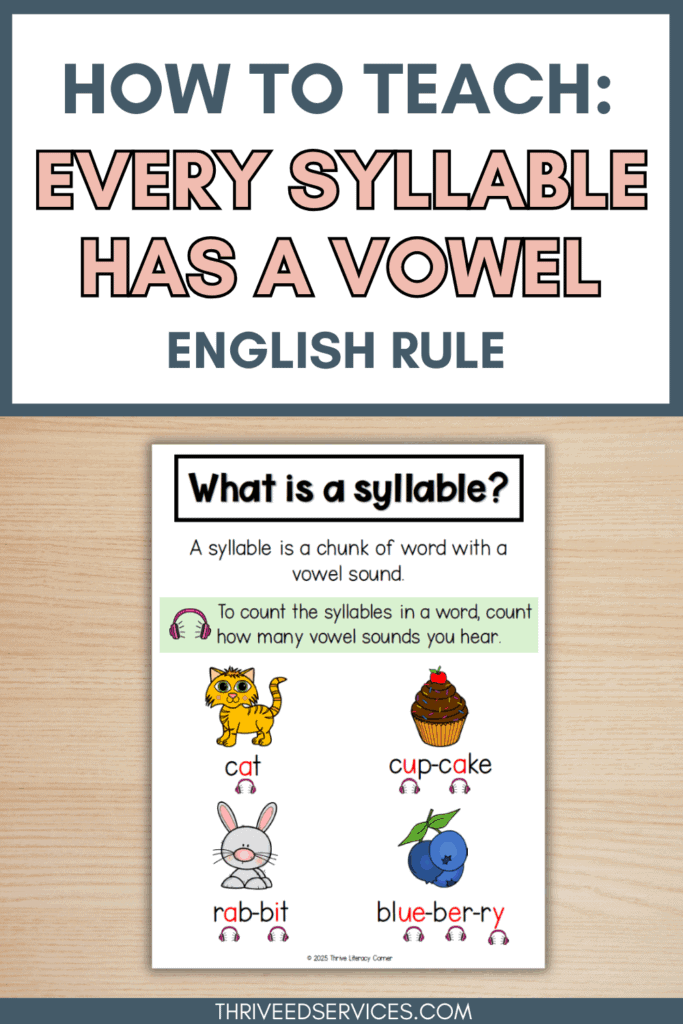
A syllable is an uninterrupted segment of sound formed by opening and closing the mouth to create a vowel sound.
Every syllable must include a vowel sound, because vowels are what make the “beats” in words.
Some syllables have two vowel letters that work together to make one sound, such as ea in meat.
You can count syllables by focusing on vowel sounds, not vowel letters.
How to Count Syllables
Here are a few simple ways to help students count syllables accurately:
- Clap It Out – Say the word slowly and clap for each vowel sound.
- that → 1 clap
- nap/kin → 2 claps
- Chin Drop Test – Place a hand under your chin and say the word. Each time your chin drops, that’s one syllable (one vowel sound). This works because your mouth has to open to make vowel sounds which makes your chin drop.
- Hear the Beats – Stretch the word orally (ba-na-na). Each “beat” is one syllable.
Remind students that we count vowel sounds, not vowel letters. Words like meat have two vowels but only one vowel sound.
A quick note: You’ll hear this called a rule, but I like to frame it as a pattern. Most of the time it works this way, but not always. When I introduce it to kids, I tell them: “This is what usually happens in English words, but there are some exceptions we’ll learn together.”
Grab your FREE 6 syllable types posters & word lists by subscribing to my list!
*Most school spam filters block my emails, so please use a personal email.

The Pattern: Every Syllable Has a Vowel
Once students know what a syllable is, teach them that every syllable must have a written vowel.
That means there will always be at least one vowel letter – a, e, i, o, u, or sometimes y – in each syllable.
Without a vowel, you can’t have a syllable, because vowels create the sound that makes the syllable possible.
Examples:
- ta/ble
- ap/ple
- a/bout
- pen/cil
- bas/ket

Addressing the Rare Exceptions
There are a few English words that seem to break the “Every Syllable Has a Vowel” pattern (words like prism, logarithm, sarcasm, and feminism.)
At first glance, these words appear to have a final syllable (-sm) with no vowel letter. But when you say them slowly, you can still hear a slight vowel sound between the s and m. That tiny sound happens naturally as your mouth moves from one consonant to another while your voice is still on.
Phonetically, every syllable in English still contains a vowel sound, even if it’s not represented by a written vowel letter. In these cases, the missing vowel letter is due to etymology, how the word was borrowed from Greek, where -ism was a suffix. Over time, English kept that spelling even though we pronounce a faint vowel sound.
How to explain this to students:
You can tell them, “Some words were borrowed from other languages and don’t follow English spelling patterns perfectly. Even if we don’t see a vowel letter, we still hear a vowel sound when we say the word.”
Examples:
- prism → pris/um (you can hear a tiny /uh/ sound at the end)
- sarcasm → sar/cas/um
- algorithm → al/go/rith/um

When to Teach This Pattern
Teach this early in Kindergarten, right alongside your introduction to vowels and syllables. This pattern sets the stage for understanding syllable types later on: open and closed syllables, silent e, and vowel teams all build from this idea.
How to Teach the Pattern
- Start with spoken syllables.
Clap out simple words (cat, robot, banana). Ask students, “How many beats did you hear?” Explain that each beat, or syllable, has one vowel sound. - Move to written examples.
Write a few words on the board and underline the vowels. For example:- ta/ble → underline a and e
- pen/cil → underline e and i
- a/bout → underline a and ou
- Identify the vowels together.
Have students highlight or color all the vowels in each word. Emphasize that every syllable needs at least one. - Contrast examples.
Write a nonsense “word” like frlp. Ask, “Can this be a real word?” Guide them to see that it can’t, because it has no vowel. - Dictation practice.
Say a few words and have students write them, then check that each syllable has a vowel.
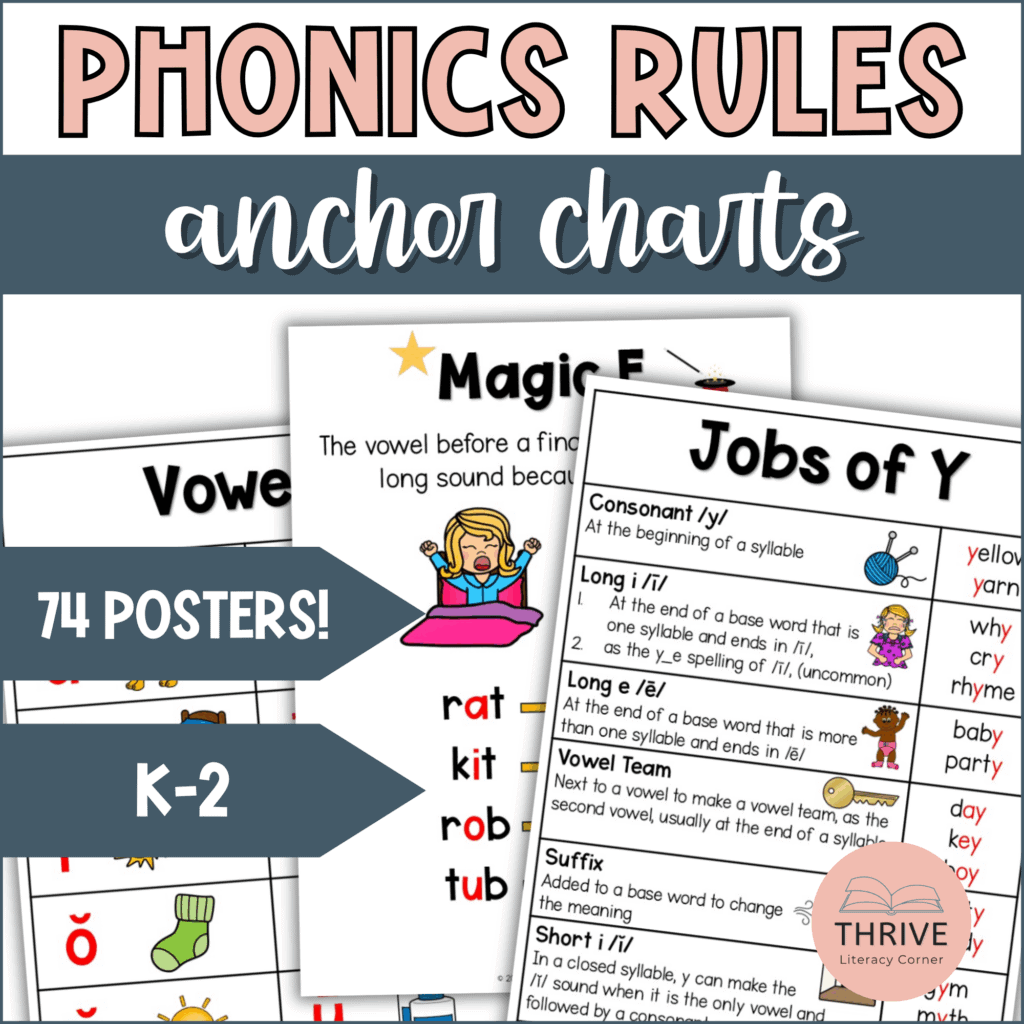
? Grab my Phonics Rules Anchor Charts which includes syllable anchor charts that explains what a syllable is and more.
Activities for Reinforcement
1. Word Sorts
Give students a mix of real and nonsense words. Have them sort into:
- Has a vowel
- No vowel (not a real word)
Examples: cat, dog, prlm, tree, wst, hand.
How to do it:
Write words on cards or slips of paper. Students read each word and place it in the correct column.
Why it works:
Sorting helps students distinguish real words from non-words by recognizing the presence of vowels.
2. Syllable Clapping
Say words aloud and clap for each syllable. After clapping, write the word and circle the vowel in each syllable.
Examples:
- that → 1 syllable
- nap/kin → 2 syllables
- el/e/phant → 3 syllables
You can have your students follow along with the video below.

3. Highlight the Vowels
Use a short passage or list of words. Have students highlight every vowel. Then ask, “Are there any words that did not have a vowel?”
4. Build-a-Word
Give consonant cards (b, t, r, n) and vowel cards (a, e, i, o, u). Ask students to create real words. Discuss why they can’t make a word without a vowel card.
5. Phoneme–Grapheme Mapping
Say a word like table. Students tap the sounds /t/ /ā/ /b/ /l/ and write one letter or letter team in each box. This reinforces that every syllable must include a vowel sound.
Why This Pattern Matters
Understanding that every syllable must have a vowel helps students:
- Decode longer words by finding the vowels and dividing syllables.
- Identify nonsense words or errors when spelling.
- Build a foundation for syllable types, vowel teams, and vowel-consonant-e patterns later on.
Connect It to Other Patterns
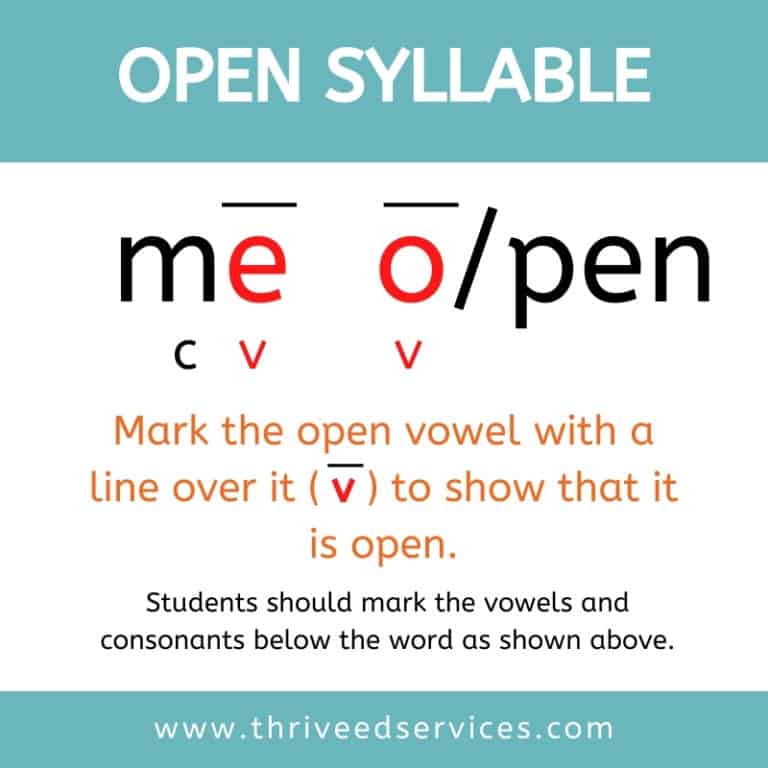
Once students grasp that every syllable has a vowel, they’re ready to learn how vowels behave in different syllable types. From here, move into closed syllables (short vowels) and the Floss Pattern.
? See the complete guide to English phonics patterns here.
Grab your FREE 6 syllable types posters & word lists by subscribing to my list!
*Most school spam filters block my emails, so please use a personal email.
Final Thoughts
This simple pattern is one of the cornerstones of English spelling. Helping students see that every syllable needs a vowel sets them up for success when decoding and spelling more complex words later on. Keep it hands-on, make it visual, and revisit it often as you move through your phonics scope.