Sight Words vs. High-Frequency Words: Stop Mixing These Up

This post may contain affiliate links, and I will earn a commission if you purchase through these links. Please read the disclosure policy for more details.
If you’ve ever used the terms “sight words” and “high-frequency words” like they mean the same thing, you’re in good company. Most teachers do. I did too.
It wasn’t until someone sat down and explained the actual difference that I realized the mistake I’d been making, and immediately understood why some of my students weren’t retaining words the way I expected them to.
These are not the same thing. They are not interchangeable. And the way you teach depends on which one you’re actually talking about.
What Are High-Frequency Words?
High-frequency words are simply the words that appear most often in printed text.
That’s it. Frequency in print. Nothing more.
Words like the, and, of, was, said, and you are high-frequency words. They show up constantly in books, so it makes sense that we want students to be able to read them quickly. The Fry list and the Dolch list are both collections of high-frequency words, organized by how often they appear in text.
Being a high-frequency word says nothing about whether a word is easy or hard to decode. It just means it shows up a lot.
What Does “Sight Word” Actually Mean?
Here’s where things get interesting.
A sight word is not a category of words. It’s a reading stage.
According to researcher David Kilpatrick, a sight word is any word a reader recognizes instantly, automatically, and without effort, regardless of how it’s spelled. It doesn’t matter if the word is regular or irregular. What matters is that it’s been stored in memory and comes back immediately when the student sees it.
By that definition, cat can be a sight word. Elephant can be a sight word. Photosynthesis can be a sight word. Any word a student has fully committed to memory is a sight word for that student.
Your adult sight word vocabulary is likely somewhere between 30,000 and 70,000 words. Every time you read this sentence without stopping to decode each word, you’re reading sight words.
The goal of reading instruction is to get students to that point, where more and more words become automatic. Not to hand them a list of 100 words and tell them to memorize the shapes.

Why Mixing These Up Matters
When teachers treat high-frequency words as a fixed category of words that must be memorized, a few things go wrong.
First, students are drilled on flashcards with no connection to the sounds in the word. They try to store the word as a visual shape. For most students, that doesn’t stick, especially for kids with dyslexia or weak phonological awareness.
Second, when students forget the word, they guess based on the first letter or the overall shape. You’ve probably seen this. A student sees was and says “went.” They’re not decoding. They’re guessing based on visual memory.
Third, teachers end up frustrated because the words aren’t “sticking,” and students feel like failures when they can’t recall a word they’ve reviewed 20 times.
The reason? The brain doesn’t store words as whole pictures. The brain stores words by mapping sounds to letters, a process called orthographic mapping. That’s how any word becomes automatic, including high-frequency words.
How Words Actually Become Automatic: Orthographic Mapping
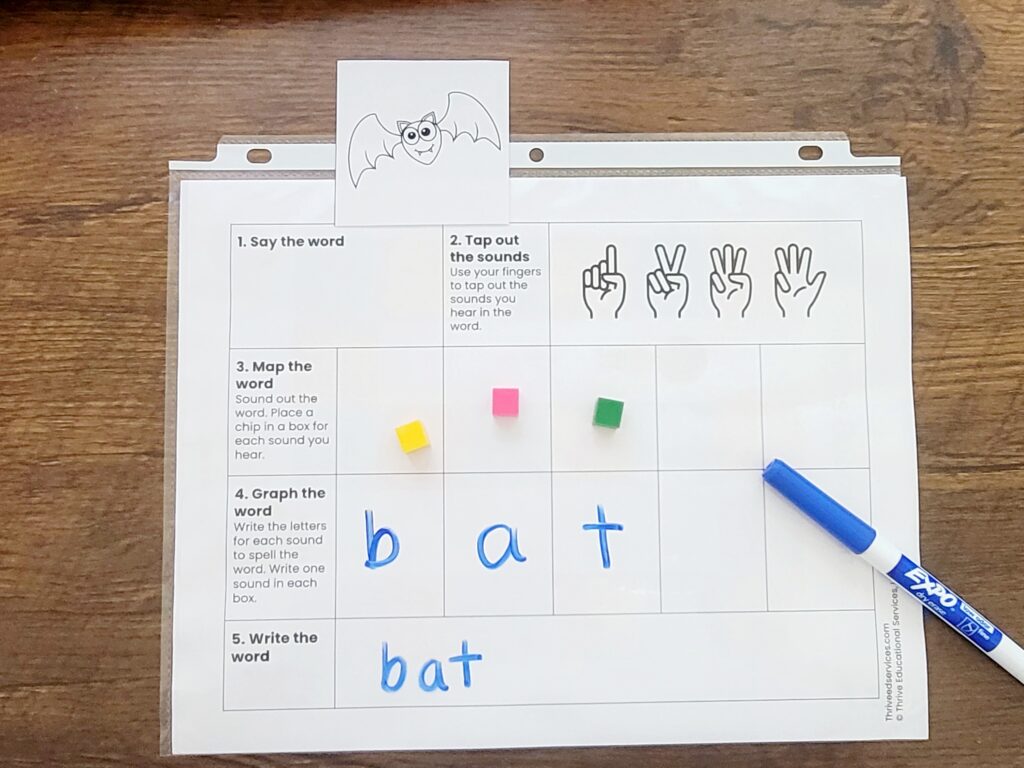
Orthographic mapping is the process the brain uses to permanently store a word. Our brains use what we know about letter-sound relationships plus our awareness of speech sounds to map letter patterns and words together as units, which are then stored in long-term memory.
In plain terms: students need to connect the sounds they hear in a word to the letters that represent those sounds. When that connection is made and reinforced, the word moves into long-term memory and becomes automatic — a sight word.
This is why teaching phonics and teaching high-frequency words are not two separate things. Phonics instruction is what makes high-frequency word learning possible. The practice of memorizing lists of words will not lead to a sight word vocabulary if it is not paired with the teaching of phonics and phonemic awareness.
If you want to see exactly how phoneme-grapheme mapping works in a lesson, I have a full post on word mapping activities that walks through the process step by step.
Where Heart Words Fit In
Now, here’s the complication: not every high-frequency word follows regular phonics patterns. Some have irregular parts.
Take the word said. The sounds are /s/ /ĕ/ /d/ — but the middle sound /ĕ/ is spelled ai, which typically says /ā/. That’s the irregular part.
This is where heart words come in.
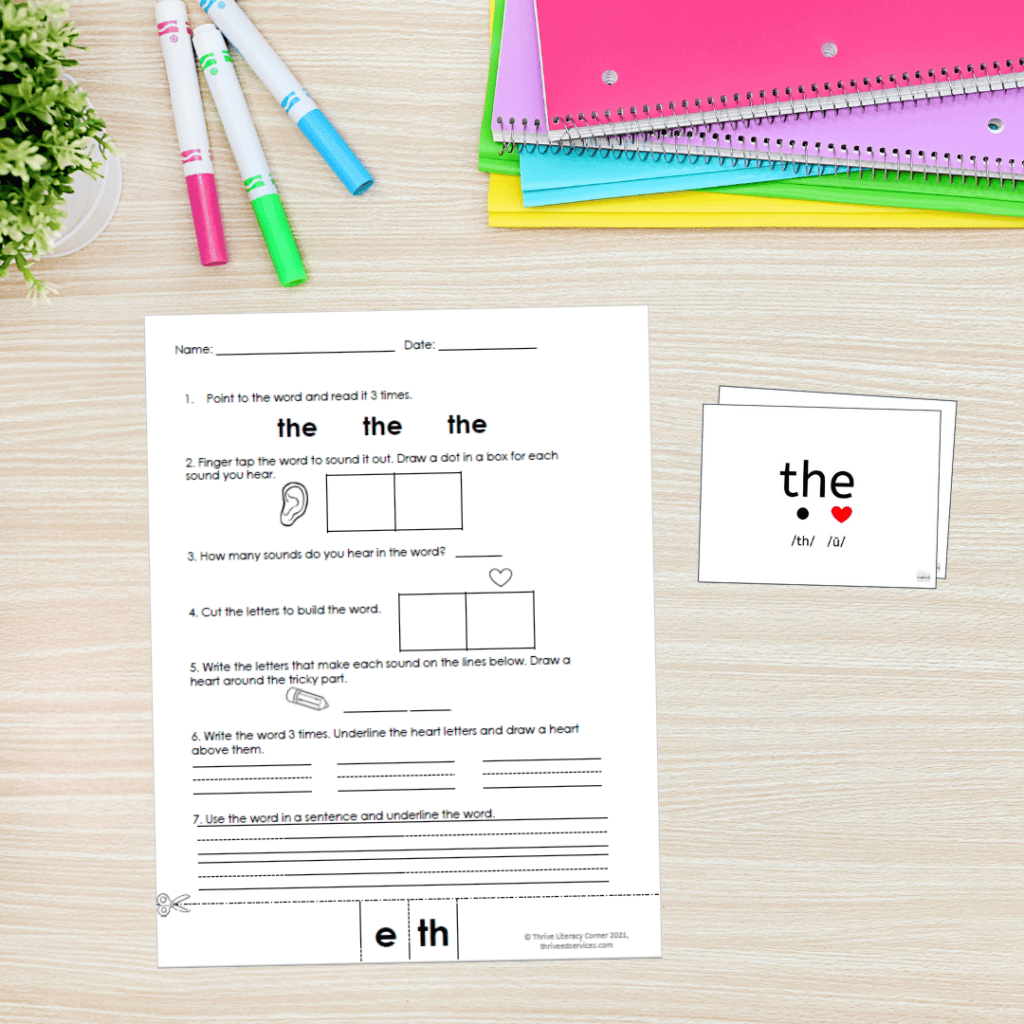
Heart words instruction explicitly maps all the sounds in a word to letters, then marks the irregular part with a heart. Students learn: “Most of this word sounds exactly the way it looks — but this part? We have to know it by heart.”
This is not memorization. It’s targeted, explicit instruction on the one piece of the word that doesn’t follow the pattern. Students still connect sounds to letters for the regular parts. They just learn that the heart part needs extra attention.
It’s a completely different mental process than telling a student to look at a flashcard and remember the whole word shape. And for most students, it works much better.
If you want the full breakdown of how to introduce and practice heart words with your students, I have a dedicated post on the Heart Word Method that covers it in detail.

What to Stop Doing
If you’re currently doing any of these, it’s worth reconsidering:
- Drilling flashcards without any phonics connection. When students see a word on a card and try to recall it visually, you’re asking them to memorize something their brain isn’t designed to store that way.
- Treating every high-frequency word as undecodable. Many high-frequency words are actually perfectly regular. In, and, had, him, did — these can all be sounded out. Teaching them as if they’re irregular sends the wrong message.
- Expecting memorization to stick for struggling readers. Students with weak phonological awareness are the ones who most need explicit sound-to-letter mapping. Visual memory approaches tend to fail them first.
What to Do Instead
You don’t need a complete overhaul. Here’s what to do with high-frequency words going forward:
- Map the sounds first. Before anything else, identify how many sounds are in the word. Say the word, count the sounds, and represent each one. For was: three sounds, /w/ /ʌ/ /z/.
- Connect sounds to letters. For each sound, identify what letter or letters represent it. For was, the w is regular, the a represents an unexpected /ʌ/ sound, and the s represents /z/. Show all of this explicitly.
- Mark the irregular part. Draw a heart over the part that doesn’t follow the expected pattern. Tell students: “This is the part we have to learn by heart.”
- Practice in context. Students need to see and use the word in text, not just on isolated flashcards. Reading it in connected text helps the brain consolidate it.
- Review cumulatively. Spaced review of previously taught words is far more effective than drilling new words in isolation. Keep coming back to words students have already learned.

Resources
If you want a ready-to-use set of heart word materials, I have many printables in my shop that uses the Heart Word Method approach. You can also read my post on how to teach heart words for the full step-by-step before you decide what you need.
And if you want a broader overview of where high-frequency words fit in your literacy block, grab the free Science of Reading Quick Start Guide below.
SCIENCE OF READING QUICK START GUIDE
Grab your FREE guide with the 5 tools you need to get started with SOR!
*Most school spam filters block my emails, so please use a personal email.

One Thing Worth Knowing Before You Go
High-frequency words and sight words are not the same. High-frequency words are a category of words in print. Sight words are what any word becomes once a student can read it automatically.
When we treat high-frequency words as a memorization list, we skip the instruction that actually makes them stick. When we explicitly map sounds to letters, even in irregular words, we give the brain what it needs to store the word for good.
You don’t need to throw out everything you’ve been doing. Start with one or two words this week. Map the sounds. Mark the heart. See what happens.
That one small thing makes a bigger difference than reviewing 30 flashcards ever will.